Thursday, August 21, 2014

Skid Row Diary 31


4  October   2003     Saturday    Day 84


   I was awoken at approximately 5:30am by a loud, determined knock on my door. I leaned over and opened it.
   “Security! Just checking. An alarm went off somewhere up here. Everything okay in here?”
   “Yeah, yeah. Everything’s okay.”
   He left. I returned to sleep for about 45 minutes. When I did get up, I showered and drank a fast cup of coffee, then left the building to meet Ron McCree.
   “Money’s on the street,” he muttered, as if to say hello.
   “Money’s on the street?”
   “Yeah,” he said. “Money’s on the street. That’s why it’s so empty.”
   He was referring to the fact that it was close to the beginning of the month, and a large faction of the homeless had cash in their pockets from recent GR and social security payments. I myself had some of that cash.
   We expanded our walk to the south, going down all of the way to 9th St., leaving the Heroin and Fish Districts briefly to skirt the outskirts of the Prostitute District.
   “You ever been to the peanut place?” Ron asked me.
   “No.”
   “You never been to the peanut place?”
   “No Ron. I myself, personally, have never, ever, to the best of my knowledge, been to the peanut place.”
   “Well,” he said, “there it is.”
   I looked across the street and espied a large, dark, one story building, with several signs protruding from various places proclaiming, “Peanuts for Sale.”
   “You can get as many peanuts as you want in there,” Ron told me. 
   “There’s no limit, huh?”
   “Naw. You can get a little bag and fill it up, or you can get a great big sack, it doesn’t matter. It’s closed right now though.”
   “Yes," I agreed. “If it wasn’t I suppose there would be a great big line of people waiting to get some peanuts, there being so much money on the streets, and all.”
   He gave me a strange look.
   “They don’t want no peanuts, man,” he said.
   We continued on our way.
   Spotting no pretty girls to rescue today, we rarely stopped walking. Ron looked for bargains as we passed the Flower Market.
   “I love beautiful women and flowers. If you want to see a lot of beautiful women, come here early in the morning,” he told me.
   We were there early in the morning. I saw no beautiful women hanging around.
   “I don’t like water on the street though,” he told me as we passed one of the flower shop workers washing down the sidewalk. “I can’t deal with it early in the morning.”
   “We’ll make through this somehow, Ron.” I realized my friend is about half crazy.
   Well it takes all kinds, and you know what they say...
   We ended our tour at a place where people would come and give away chicken dinners in about 20 minutes. 
   I took my leave of him after discussing my plans to move up north eventually. He was going to walk me back to the Weingart, but got diverted when he saw a line of people waiting for free soup. We made plans to meet on Monday.
   I went to the dinning hall for a nice pancake and bacon breakfast, discarding the bacon fat, eating only lean pieces of pork.
   Then off to Trimar. In North Hollywood, upon exiting the subway station I saw a 156 bus waiting, which was the one I needed to get to Van Nuys. I hurried up to it before it took off, and was the very last to board before it did leave, in the wrong direction from that which I needed to go. It was headed back downtown, to where I had just come from.
   Such is life.
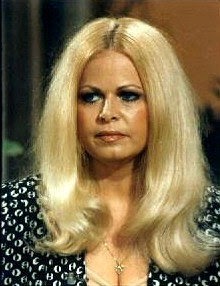
   I had a good look at downtown North Hollywood, what is called the NoHo Arts District,  as I walked three blocks back to the bus depot. I passed the El Portal Theater where I had first seen  the movie “Mary Poppins,” and many other fine films. Now the facility featured live stage performances, this week featuring Sally Struthers of “All in the Family,” fame, in some play.
   I finally got on a 156 that was headed in the right direction. In Van Nuys I visited the 99 Cent Store to pick up a few things. 
   My backpack was quite heavy for the rest of the trip, which would prove tiresome later as I wandered around the streets of Hollywood. It contained 2 cans of meatballs in tomato sauce (you can never have too many), 2 jars of instant coffee, a bottle of ranch salad dressing, a jar of mayonnaise, a jar of sliced jalapeno peppers, 6 little cans of spreadable spam, 1 can of chile (no beans), 1 tube of cheese, peanut butter, cookies, 1 package of “Snackers” (snack crackers),  and 9 packs of Top Ramen (chicken and spicy chicken). I would later buy some 3 Musketeers bars, microwave and pre-popped popcorn, and 1 twenty six once box of iodized salt (it’s extremely important to get iodized salt, in case of nuclear attack. That way radioactive iodine can not enter your thyroid because iodine from the salt is already there). 
   No movies of course, at Trimar anymore. I found myself watching a curious cartoon program concerning the adventures of an elf clan, who looked suspiciously like leprechauns, in a cave. I was thinking that it wasn’t as easy to walk upside down on the roof of a cave utilizing suction cups on their shoes as they made it look, when my name was called to have my vital signs taken.
   Low blood pressure today, which I found mildly interesting. 90/64, which was just within acceptable donation limits. I asked my beautiful friend Aurica what might cause low blood pressure.
   “Garlic,” she said. “Did you eat some garlic, maybe?”   
   “Not to my knowledge, although someone could have spiked my pancakes with the stuff. You would think  I would have noticed though.”
   It remains a mystery. However, low is better than high, I guess... until I began fainting due to my poor overworked brain not getting enough oxygen rich blood.
   I also asked Aurica if she thought if there were any health benefits to donating blood plasma on a regular basis.
   “None that I can see,” she told me.
   I was trying to manufacture a reason to continue donating, but there wasn’t one really.
   After saying goodbye to Aurica, and leaving the center, I caught a 154 going south, which took me all of the way back to the North Hollywood station.
   McCree had told me where I might find a Tower Records store, so I got off of the subway at Hollywood and Highland. 
   I walked out onto Hollywood Blvd. and saw no record store. I did see lots and lots of tourists walking up and down the Walk of Fame, and hanging out at Grauman's Chinese Theater, where all of the people from China go to the movies.  
   I first walked west a few blocks, hoping I would see the store lurking somewhere. I did find Bob Hope’s star, but little else. A guy dressed as Homer Simpson, standing next to Spiderman, handed me a coupon for a discount at Universal Studios. I walked east, paying homage to Mark and Brian’s star, in front of the Wax Museum. I couldn’t find any record store. I abandoned my masculinity and asked someone who happened to be walking by, as if they would know where it was.
   “Near Vine,” I was told. 
   Great. I walked on Hollywood Blvd. the five or six blocks to Vine St., my backpack getting heavier with every step. 
   This Venus Hum CD better be good, I told myself.
   I got to Vine. No Tower Records, or any other kind of record store. 
   I gave up. To hell with it. I’d find the address on the Internet.
   I got back on the Red Line at the Vine Station, and made my way back downtown.
   As I approached the bus stop on 5th Street, where the 53, or the 18 would take me to the Weingart, a 53 bus came and went before I could get to it. Next, before another 53 or an 18 came, I saw five number 16 buses, and four Red Express buses pass by. I’m so glad that those routes are covered so extensively. When an 18 did arrive, another 18 was right behind it, and a 53 behind that one.    
   I enjoyed about half of a filet of fish sandwich for dinner, then discovered where Tower Records was on the computer in the day room... two of them, on Sunset somewhere. 
   There’s one in Pasadena at the mall, a Sam Goody as well. Perhaps I’ll go there. 
   I heated half a bag of old popcorn. I consumed said popcorn while watching the “African Pituitary Gland  Eater,” episode of “The X-Files,” which I also taped.
   A few minutes after that ended I left the building and walked to Gladys Park.
   Someone was practicing on their drum set behind a fenced enclosure. The primitive beat reverberated throughout the neighborhood, and through the air of the dark, clean night.
   I was attending the Drifters AA meeting of course. I got myself a cup of coffee, sat down, and began to write before the meeting got started. Some people knit sweaters, some eat their dinner or lunch while listening to the meeting. I write.
   My back was a twidge sore.
   I volunteered to read from chapter three from the Big Book of Alcoholics Anonymous. It had been a long time since I had read it, and I stumbled through it quite inexpertly. I didn’t care, I told myself. I only did it because no one else volunteered.
   As I was getting a second cup of coffee, a short, squat, mustachioed man came up and embraced me. I said hello. 
   “Do you remember me?” he asked.
   This happens to me quite a lot at meetings, and other places at times.
   “No. I’m sorry...”
   “From the Salvation Army. We were there together.”
   “Which one?”
   “Pasadena.”
   “What year?”
   1990, he said. So I had met him when I had first arrived. At the beginning of the Diary. Perhaps he’s in the Diary, I’ll have to check. His name was Rick, which seemed oddly familiar.
   I sometimes meet people from the ARC days, and remember their faces, but not their names. There were so many. Often I try to remember if I had had any part in having them thrown out, and attempt to determine if they’re still mad about it.
   Rick wasn’t mad, and I hadn’t thrown him out. If I had indeed met him in 1990 I hadn’t been an employee yet. He was glad to see me, and I was glad that he was doing well. He told me he would be coming back Monday night for another panel and invited me to come back. I said I would.
   As I wrote, listening to Yvette tell her tale, a L.A.P.D. helicopter passed about 200 feet directly over my head, going west. 
   I don’t mind blimps or helicopters, it’s pigeons I’m worried about.
   This meeting only lasts an hour, so at 8:30 I left and returned to the Weingart, and continued writing.
   Although there were a goodly supply of movies on the telly, I haughtily ignored them and went to sleep after I finished writing for the day. 
   I dreamt I was cruising in a helicopter at night, over Los Angeles, with Sally Struthers, Hope Davis, and Sharon Mitchell, the lovely and talented star of “Hard Trip,” “Feel My Sting,” and many other fine films, and the founder of the Adult Industry Medical Health Care Foundation.    We landed briefly on the roof of the Library Tower, the tallest building west of the mighty Mississippi, for caviar and truffles before lifting off for Long Beach, and the Queen Mary, the very ship that brought my father home from World War II. 
   We came aboard and looked for ghosts.


 5  October    Sunday   Day 85


   I slept in late, until 6:30, after which I took a long, hot shower, then exercised and meditated.
   Scrambled eggs for breakfast. I purchased Sunday’s paper from the Hollymart.
   I listened to an NPR interview with Stacey Kent, an American jazz singer I may have to investigate further.
   And I wrote until it was time to leave for Higashi Honganji.
   Reverend Ito’s sermon dealt primarily with our ideas of self within the world, citing the statistical idea of widdling down the world’s population of the current 6.3 billion down to a village of 100 people. 53 would be Asian, 20 Christian, etc. He noted that anyone who had change in their pocket, and ate on a regular basis lived within the wealthiest 8% of the entire world’s population. If you owned a car your position would be upgraded to the top 7. 
   The idea that just because through an accident of birth, that I live in the United States, I’m better off than 92% of the rest of planet’s citizen’s is a little unsettling. We Americans take our privileged position for granted, and quite frankly are a tad spoiled.
   Just imagine what it would be like to be born a gopher, like the one who appears in the last chapters of Steinbeck’s “Cannery Row.” Then you’d really be fucked.
   After the service I sought out Rev Ito to introduce myself, and give him the “The True Founder of Zen,” quote from Arthur C. Clarke’s “The Fountain’s of Paradise:”
   “Driven to despair by his fruitless attempts to understand the universe, the sage Devadasa finally announced in exasperation:
   “ ‘All statements that contain the word God are false.’
   “Instantly, his least-favorite disciple, Somasiri, replied:
   “ ‘The sentence I am now speaking contains the word God. I fail to see, oh Noble Master, how that simple statement can be false.’
   “Devadasa considered the matter for several Poyas. Then he answered, this time with apparent satisfaction:
   “ ‘Only statements that do not contain the word God can be true.’
   “After a pause barely sufficient for a starving mongoose to swallow a millet seed, Somasiri replied:
   “ ‘If this statement applies to itself, oh Venerable One, it cannot be true, because it contains the word God. But if it is not true—’
   “At this point, Devadasa broke his begging bowl upon Somasiri’s head, and should therefore be honored as the true founder of Zen.”
   From a fragment of the Culavamsa, as yet undiscovered
   I had printed it for him in the hope he would find it amusing. But he’s a wily fellow, and could not be found. I left and had lunch at the Weingart.
   Veggie melt.
   Then to Pasadena to pick up some books from Barnes and Noble, via the Gold Line. I acquired Dean Koontz’s “Winter Moon,” Stephen King’s “Carrie,” and “Firestarter,” Carl Sagan’s “Broca's Brain: Reflections on the Romance of Science,” “How to be Your Own Best Editor,” by Barry Tarshis, “Chaos,” by James Gleick, “How the Mind Works,” by Steven Pinker, and three law books dealing with bankruptcy, tenant’s rights, and buying a house.
   I stopped at Moby Disk before heading back to see what videos they had to offer, and found a copy of “Blade Runner,” which I just had to have, and the classic, “Stoned Age,” starring the beautiful and talented Renee Griffin. 
   I checked the CDs briefly, hoping to find Sophie B’s “Timbre,” but like Reverend Ito, it was not to be found. Idly checking the the “V’s” lo and behold, I found Venue Hum’s “Big Beautiful Sky,” for only $7.99. I snatched it up faster than you could say “Jack Mcdoogalpartifoculzenback.” The only problem being I didn’t have enough cash left to buy all three items.
   I hid the cover of “Stoned Age,” to hopefully retrieve it at a later date, and brought “Blade Runner,” and the CD back to my lonely room. 
   I played “Soul Sloshing,” 47 times.
   I also danced.
   I like the song, what can I say. I know it’s a little techno-pop number, but it’s constructed well, has interesting lyrics, and Annette is a wonderful singer. 
   She has a nice voice as well.
   I also liked the song “Montana,” which the album’s... album... I’m so old, from which the CD’s title is derived, and where I would learn tomorrow at the library, Annette came from. The band originated in Nashville, of all places. I don’t know where I got the idea they were British. I may have experienced an alcohol flashback, I’m not sure.
   Well, we know how those Montana girls are. Nasty, nasty. But I discovered that Annette, my new love, is married to some guy named Kirk, who is clearly not good enough for her.
   Annette, why, oh why, couldn’t you have waited for me!? I would have shown up... eventually, to help ease your loneliness...
     It was not meant to be I suppose.
     I hope Sophie will take me back.
   Perhaps she’s married too! Oh no. She’s too wild to get tied down. You know how those New York girls are. Nasty, nasty.
   I read the paper and wrote. At 9:00PM I tried to tape the PBS presentation of the Westport County Playhouse’s rendition of Thornton Wilder’s masterpiece, and one of my favorite plays,  “Our Town.” However I couldn’t get good reception, and was forced to abandon the attempt, which placed me in a foul mood, I can tell you. I ranted. I raved. It did not help. I almost threw the VCR out of the window when in fact it was the T.V.’s fault. I surprised myself actually, with the purity of my emotions.
   I continued to watch the play though, be damned the reception, and quickly fell under the play’s spell. 
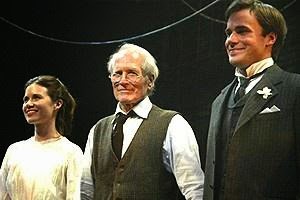
   Discerning readers might know why I love this play so much. It’s themes are of particular interest to me. Our everyday lives that we often take so much for granted, of which we are hardly ever aware of because we’re always so, so busy. The meaning of our lives and our place in the universe. Simple things that upon reflection have great significance... a wedding for example, or a sunset, and appreciating the stars that shine at night (refer to Salvation Diary for quite an extensive list), our hopes and dreams, all laced within a simple framework of the banal, familiar, and mundane. I pretty much cried throughout the whole thing, it was so beautiful to me. It was almost too painful to watch. The cast, headed by this very talented actor by the name of  Paul Newman, was wonderful. By gosh, if he keeps up work like this he’ll be really good some day. 
   I was just over awed by the whole thing.
   However, they managed to piss me off at the end. The credits were so small on my screen, and moved so fast that I could not see the name of the actors, and I really wanted to find out who had played the part of Emily Webb. I was absolutely livid for an hour and seventy five minutes. My anger at my VCR, and now my T.V. reawakened.
   I was so mad that I taped the 11:00 broadcast of “The X-Files,” for no good reason, although at the end of this “Zombie Apocalypse,” episode, Mulder gave Scully a really good New Years smack right on the lips. She liked it! You know how those FBI girls are.
   Nasty, nasty.
   I listened to the Impact radio program, to Frankie Sontag deride Arnold Schwarzenegger for awhile, for 2 hours actually, until I finished some writing and reading of the paper that I wanted done.
   I finally went to sleep and dreamt I was in Grover’s Corners with Maggie Lacey, who I later discovered, through exhaustive research (looking on the Internet) was the wonderful actress who had played Emily. We were in the drug store, sitting at the counter, sipping strawberry sodas, and she was talking of my character. 
   When we were finished I had to admit to the proprietor of the store, a Mr. Morgan, who looked an awful lot like that actor guy Paul Newman, that I’d have to come back with the money for the sodas. I had neglected to bring enough with me.   
   “You trust me, don’t you Mr. Morgan?” I asked plaintively.
   “I’ll trust you for ten years,” he replied. “Not a minute more.”


6   October      Monday    day 86


   I slept in late, until 7:00, and listened to Mark and Brian berate Frankie for admitting he had once seen a UFO, a ghost, and Tahoe Tessie. One can only hope he saw them at different times.
   I noticed that when I turned on the light switch to the two lights that provide all of the man made photons for my little room, the two fluorescent bulbs glowed in an orange manner, not  activating completely. It wasn’t hard to notice.
   I left my lovely case worker, Labren, a message on her voice mail asking her to have maintenance check it out. 
   I fooled around with the bulbs until they eventually did light, but I could no longer trust them. They’ve betrayed me once. I wouldn’t give them a chance to do it again.
   As luck would have it, I spotted a maintenence type person down the hall working in a different room. He was at work rather early, but I took advantage of the situation and asked him to check out my bulbs when he had a moment. A little while later he came in and switched on the lights, which worked perfectly of course. I told him what had happened. He wiggled the bulbs around, checked the balance, and left. I thanked him and left another message for Labren canceling my maintenence order. 
   Now the song “Montana,” keeps repeating itself through my disheveled and undisciplined mind. 
   The one thing about the song “Soul Sloshing,” is that’s it’s a bit complicated in a way that’s a little hard to remember. At least for me. Not so with “Montana.” That one’s easy to remember, and keeps going and going, like the Eveready Bunny.
   I went to breakfast at 8:00, then to the Levi Center, where I had Larry fax my resume to a couple of places. 
   This makes him feel needed.
   I walked over to the Mental Health Department on Maple Ave., for a 9:30 appointment with Dr. Perry. He seems to be doing well, getting enough sleep, and all. I let him know what was happening in my life... CWT, the Skid Row Housing Trust, ASAP, Tahoe Tessie, etc. I didn’t mention my dreams for fear that he have me locked up.
   “I looked up DSM four, three one one,” I told him.
   “Oh. Did someone provide that diagnosis?” 
   “Oh yeah. This office did for DPSS. Wasn’t it your diagnosis?”
   “No. The person you were seeing before me did, who was not a doctor. I would have used two nine six, three three.”
   “Two nine six, three three?”
   “Yes.”
   “Great. Now I’ll have to look that up. Could you write that number down please?”
   He wrote me a prescription for more Prozac and Wellbutrin. 
   Dr Perry still doesn’t know that I’ve stopped taking the Prozac, and once I finish the bottle of Wellbutrin, I’ll stop taking that too.
   I made an 8:00 appointment for December 3rd, then had my prescriptions filled at the Nofel   Pharmacy on Spring and 5th.
   I signed in at SRHT, and continued walking east on The Nickel to the Service Spot. Ron McCree was there waiting for me. We had some nice coffee, and he told me that after I left him on Saturday he had gone to the General Hospital (Los Angeles County+USC Medical Center, or The House of Death) to get some asthma medication. One now needs to assume that he suffers from asthma. I soon left him, making plans to meet him later in the week.
   I returned to my room and wrote. After lunch (Teriyaki Chicken) I made it to the 1:00 ASAP meeting, having my urine tested while there.
   Riding the DASH I thought up a perfectly viable pilot for an hour long television drama concerning a World Court/Amnesty International agent, who hunts down human rights violators and indicted but hard to find war criminals. Sounds like a natural to me. A little different than your usual police, detective, spy, vampire, doctor, lawyer, gynecologist, FBI agents seeking vampire fair. You’ve got your drama, you’ve got your adventure. They’ll certainly be laughs galore... and most importantly, it’s socially relevant. 
   I also thought about making a film about the 9/11 tragedy, focusing on the plane that crashed in Pennsylvania, the one successful defensive act that occurred on that terrible day. I think it’s been long enough, and I feel the story needs to be told, perhaps in a documentary fashion. 
   I think that it’s important that it be done. I also think it’s important to a degree, to depict the attacker’s point of view. The reasons behind the attack. They didn’t do it just because they didn’t have anything else to do that day.
   I looked up some items on the computers in the library before returning to the Weingart, to write, meditate, and read from “The Hellfire Club.”
   I watched “Las Vegas,” again, and was very agitated that Nikki Cox made only one brief (20 seconds) appearance in the hour long drama. She walks up wearing a low cut gown, says a few words, and walks away. 
   Hell, I could do that!
   I don’t think I’ll watch again. Like I said, I’ve already seen “Casino.”
   I happened to be watching The Tonight Show, with guests Katie “Gams” Couric, and Al Franken. Al’s recent statements seem to have been vindicated with Rush Limbaugh’s forced resignation from ESPN for making racist remarks, and rumors of addiction to pain pills (in all fairness, I believe that Rush is suffering from some form of cancer, brain cancer probably, as he seems to have lost a lot of weight recently).
   But what I found especially intriguing while watching, was a commercial for my candidate for governor, Mary “Mary Carey” Cook. It was about 30 seconds long, and totally took me by surprise. At first she was wearing a lumpy jump suit, which she soon removed, revealing her in her normal, and expected, electoral uniform, a red, white, and blue (in that order) bikini. She mentioned something about breast implants, and some other things I couldn’t quite catch, before turning her ample backside to the camera, and saying enthusiastically, “California, let’s kick some ass!”
    “Paid for by Citizens for Mary Carey for Governor.”
   And then it was over. I sat up that night a good deal longer (even through that awful Carson Daly! Who is this guy? All I know about him is that he dates actresses and then breaks up with them) then I had intended to, hoping to see it again so I could tape it and own it forever and ever, but it never came back on. Perhaps it was a one shot deal on the eve of the election.
   Well tomorrow we’ll find out if her sneak attack strategy worked. I for one, certainly hope so.
   After I resigned to the fact that I wouldn’t see Mary again, I went to sleep and dreamt I was in Bosnia with my new friend Annette Strean, hunting down Ratko Mladic, in order to take him to the Hague so he could keep Slobodan company. 
   Perhaps they could get a game of Risk going.

Tuesday, August 19, 2014

Rosetta


 And that those who have been given the knowledge may know that it is the truth from your Lord, so they may believe in it and their hearts may be lowly before it; and most surely Allah is the Guide of those who believe into a right path. -022.054 Qur'an

These are the snows of yesteryear, the pristine remnants of the origen of the solar system, waiting frozen in the interstellar dark. Out here trillions of orbiting snowbanks and icebergs are stored, gently suspended about the Sun. They cruise no faster than a small propeller-driven aircraft would, buzzing through the blue skies of far off Earth. The slowness of their motion just balances the gravity of the distant Sun, and, poised between feeble contending forces they take millions of years to complete one orbit around that yellow point of light. Out here you are a third of the way to the nearest star. Or rather, to the next nearest star: In the depth and utter blackness of the sky around you it is entirely clear that the Sun is one of the stars. It is not even the brightest star in the sky. Sirius is brighter, and Canopus. If there are planets circling the star called the Sun, there is no hint of them from this remote vantage point. -Carl Sagan, Ann Druyan, Comet 


Picture Legend

1. Rosetta
2. Muslim Empire
3. Fort Qaitbey
4. Door Stones
5. The Rosetta Stone
6. Detail
7. What the complete stone may have looked like, courtesy Captmondo
8. Average Fourth Grader
9. Ptolemaic Empire
10. Ptolemy V
11. Michetta
12. Rosetta orbit
13. Rosetta
14. Rosetta
15. Rosetta
16. The Target
17.  Napoleon
18. Voyager 1
19. From left to right:  Klim Churyumov, ESA Director General Jean-Jacques Jordan, Svetlana  Gerasimenko
20. The Kuiper Belt
21.  The Asteroid Belt
22. The Oort Cloud
23.  67P’s orbital inclination
24.  Philae
25.  Launch
26. A Long and Winding Road
27. Rosetta Takes a Peek at Earth, March 2005
28. Moonrise, March 2005
29. Mars flyby  February 2007
30. Mars as seen by Philae
31. 2867 Šteins
32. Lutetia
33. 67P/Churyumov–Gerasimenko, August 7th
34. Comet Crater
35. Detail
36. Detail
37. Detail
38. November Landing


   Al-Hādī, The Guide, is one of the 99 names of God in Islam. One transliteration (the conversion of a text from one script to another) of Al-Hādī is the Arabic word Rashid, which itself is the transliteration of two male given names; (‎Rāshid and ‎Rashīd). It’s all very complicated, in a philological sense.
   The western name Rosette or Rosetta ("little rose") are corruptions (or a degenerative evolution) of a Coptic toponym (Egyptian language in use from the 2nd to the 17th century, describing a place name, especially one derived from a topographical feature), Trashit.
   Hey, I don’t make up these names.
   Rosetta (31° 24′ 16″ N, 30° 24′ 59″ E) ‎is a port city of the Nile Delta, located about 35 miles northeast of Alexandria, in Egypt's Beheira governorate (one of the 27 “states” of Egypt).
   The city is pretty old, compared to Los Angeles let’s say, where I live, and it wasn’t always called Rosetta. That’s the name the French gave it during the time of Napoleon Bonaparte, who sent his troops down from France to visit from1798 to 1801, because they’d had such a good time there when Louis IX first checked it out in 1249. They also called it Rosette. 
   In the past the French liked to travel a lot more than they do now.
   With their troops.
   They learned their lesson in Vietnam I guess.
   Anyway, Muhammad, the last prophet sent by God to mankind in the Islamic religion, had some uncles, the youngest of which, Abbas ibn Abd al-Muttalib (566–653 CE (Common Era)), established a line of rulers, a dynasty if you will, who ruled as caliphs (the head of state in a Caliphate, which is an Islamic state led by a supreme religious and political leader and "successor" to Muhammad), and known as the  Abbasid Caliphate, who ruled from their capital, Baghdad, which some may know is the capital of modern day Iraq, which I hear has been in the news lately.
   The Abbasid Caliphate took over from the Umayyads in 750 CE, and ruled the Muslim Empire, which was pretty extensive at the time (second picture above). As you can see in that map, the Empire included the Nile Delta. In the 850s, the Abbasid caliph ordered a stone fort to be built near the town of Rashit which would overlook the Delta, and a city grew up around it. 
   The eighteenth Burji Mamluk Sultan of Egypt, Al-Ashraf Sayf ad-Din Qa'it Bay, rebuilt and fortified the fort in 1480, during the days of Turkish occupation of Egypt that was part of the Ottoman Empire. The French threw the Turks out of the area in 1798 in the aforementioned occupation. Yet the old Fort Julian is now called Fort Qaitbey, after the Sultan.
   On July 15th, 1799, a group of French soldiers who weren’t busy blowing the nose off the face of the Great Sphinx of Giza with a cannon (that legend is probably untrue. Close examination indicates the nose was chiseled off probably in 1378 by the iconoclast  Muhammad Sa'im al-Dahr, a Sufi Muslim, who was hanged for his trouble), were strengthening the defenses of the fort when they noticed a stone, part of a structure similar to picture 4 above, but this stone was different. It had writing on it... not only that, it had three types of writing or scripts, which would turn out to be Ancient Egyptian hieroglyphs at the top, Demotic script (the ancient Egyptian script derived from northern forms of Cursive (joined-up, or linear writing) used in the Nile Delta) in the middle, and plain old everyday Ancient Greek on the bottom.     
   The soldiers informed their commanding officer, one  Lieutenant Pierre-François Bouchard, who informed his commanding officer, one Colonel d'Hautpoul. The two being officers and all, and super intelligent, thought the discovery may be important in an historical sense, and informed their General, one  Jacques-François Menou, who was in nearby Rosetta at the time.  
   Eventually the stone, slab, or stele (a stone or wooden slab, generally taller than it is wide, erected as a monument, very often for funerary or commemorative purposes) would be named Rosetta. 
   The stone is a fragment of a larger stone, the other pieces have never been recovered. It currently measures 44.2126 inches (about 3 and a half feet) tall at it’s highest point, and 29.8031 inches (about two and a half feet) wide, and 11.1811 inches (almost a foot) thick. It weighs 1675.51319 pounds, which is about three quarters of a metric ton, so it’s a heavy sucker, not something that could easily fit into one’s pocket. 
   It is made of Granodiorite, which is a phaneritic (which means the size of matrix grains in the rock are large enough to be distinguished with the unaided eye) texture intrusive igneous rock similar to granite, but containing more of one type of feldspar. 
   Isn’t that interesting.
   The front of the stone where the three scripts are incised is polished, and the sides had been smoothed. Only the back, the surface that was never intended to be seen once erected, was rough. 
   Picture 6 above represents what the complete Rosetta Stone may have looked like. Since the missing pieces were never recovered the complete text is unknown. All three sections of script have missing pieces. Most of the top section, composed of the hieroglyphs, is gone. Only the last 14 lines can be seen. All of the lines are missing parts on the right side, and 12 of them on the left. The least damaged section is that of the demotic text, the middle section, with 32 lines, of which 14 are slightly damaged on the right. The Greek text, the bottom section, suffered a diagonal break on the lower right of the stone, and contains 54 lines of readable text, of which 27 are full. 
   Why is the discovery of the Rosetta Stone important? Good question! I’m glad you asked.
   Before the discovery of the stone there was no one around who knew how to decipher  Ancient Egyptian language and script, especially the hieroglyphs. They were nice pictographs of two dimensional men and women, alligators, and lions, and other things, but no one knew what they meant. Anyone who knew what they meant had died a long time ago, a long, long time ago. I mean back to before the Romans time ago.   
   Well like most fourth graders these days specializing in foreign languages, Ancient Greek was widely known at the time of the Stone’s discovery, even to some people who weren’t Greek... or ancient, like Fourth Graders.
   It was widely believed that the three sets of script recounted the same message, just in three different languages, or the written forms of the language actually. And since we could decipher the Ancient Greek, we could extrapolate the written forms of the demotic and hieroglyphs text, thereby learning how to read other examples of these languages. In other words the Rosetta Stone was a key to understanding these two lost languages, which of course opened up a whole new understanding of Egyptian culture, dating back into the scorched sands of antiquity.  
   Who made the Stone? 
   By golly, another good question!
   But we don’t know. No one alive at the time of the discovery, or during the present, was alive when the stone was made, which is unfortunate. So there are no reliable witnesses.
   We think we know this. 
   The Ptolemaic dynasty was a Macedonian Greek (a regional and historical population group of ethnic Greeks, inhabiting or coming from the region of Macedonia, in Northern Greece) royal family which ruled the Ptolemaic Empire in Egypt during the Hellenistic period (the period of ancient Greek and eastern Mediterranean history between the death of Alexander the Great in 323 BC and the emergence of the Roman Empire as signified by the Battle of Actium in 31 BC). They ruled for 275 years, from 305 BC to 30 BC, and were the last dynasty of Ancient Egypt. Accordingly, the demotic and hieroglyph texts were well known to those who lived in the area pictured above (8), at the time. 
   It turns out that the Rosetta Stone provides the recipe for a fig paste food source inserted into a  thick pastry dough, which the authors called a Newton.
   Wait, that can’t be right. 
   Oh yes, here it is. The Rosetta Stone is an example of a decree, which of course means an official order issued by a legal authority, in this case, The Decree of Memphis (city in Tennessee, famous for pioneering various American music genres, including Memphis soul, Memphis blues, gospel, rock n' roll, Buck, crunk, and "sharecropper" country music), or if you prefer, The Decree for Ptolemy V, written at the behest of Ptolemy V Epiphanes (210—180 BC), who ruled from 204 to 181 BC. The decree was issued at Memphis in 196 BC, making it 2,210 years old.
   The decree announced the rule and ascension to godhood of Ptolemy, which didn’t happen every day, and contained concessions to the priesthood, which rewarded the priests for their support, without which it would have been very difficult to keep a handle on things in the empire, because priests back then, as they are now, are basically control freaks (and as one who lived with the Brothers of the Holy Cross for a number of years, I should know). 
   There is no definitive translation for the entire script on the Stone as there exists minor differences between the three texts, and because we are still mastering the science of translation. However, if you insist, a translation by R. S. Simpson, based on the demotic text, appears on the website of the British Museum, here
   How did it become part of the masonry of Fort Julian?
   Beats me. No one knows for sure, but the consensus is that the stone was originally intended to be displayed within a temple as it had a great deal to do with the ancient priests of the Ptolemaic era, maybe at the nearby town of Sais, which used to be a powerful base for the rulers of Third Intermediate Period of Egypt (1069–664 BC). The stone was obviously moved, probably during  the early Christian or medieval period, and was eventually used as building material in the construction of the Fort. 
   Where is it today?
   After Bouchard and d'Hautpoul “discovered” it, and reported it’s discovery to General Menou, it was moved to Napoleon's newly founded scientific association in Cairo, the Institut d'Égypte. 
   Not wanting to be left out of anything, the British came to Egypt and removed the French in 1801, and the stone came into their possession, which they stole, transporting it to London, to the British Museum (I guess they only have one museum in Britain) where it remains today.
   I’m told it’s the most visited object there.
   The Egyptians want it back.
   England wants to keep it though.
   In 2002, the directors of over 30 of the world's leading museums,  including the British Museum, the Louvre, the Pergamon Museum in Berlin and the Metropolitan Museum in New York City,  issued a joint statement declaring that "objects acquired in earlier times must be viewed in the light of different sensitivities and values reflective of that earlier era" and that "museums serve not just the citizens of one nation but the people of every nation."
  Which is a lot of museum gobbledygook for, “We’ve got it now, and you ain't gett’en back!”

   Rosetta Stone is also a proprietary computer-assisted language learning software program  published by Rosetta Stone Inc., using images, text, sound, and video to teach words and grammar of second (or third or forth) languages by spaced repetition, without translation. Rosetta Stone calls their approach Dynamic Immersion (such as in baptism), a term they have trade marked (watch out John the).
   
   Rosetta is also a ward in the Laganbank (District Electoral Area) of Belfast in Northern Ireland. 

   They used to have a bar there, at 73-75 Rosetta Road. It’s closed now because the Irish don’t drink anymore. It was called The Rosetta Bar.

   It’s also a suburb of Hobart, the capital of the Australian state of Tasmania... where the devils live.

   Virginio "Viri" Rosetta (February 25, 1902 — March 31, 1975) was an Italian soccer player. 

   They call it football in Italy, but it’s not really. It’s soccer.

   Michetta (also known as rosetta) is an Italian white bread, recognizable from its hollow, bulged shape.

   The Rosetta orbit is a complex type of orbit. Theoretically, an object approaching a black hole with an intermediate velocity (not slow enough to spiral into the hole and not fast enough to escape) will enter a complex orbital pattern, bounded by a near and far distance to the hole and tracing an oscillating pattern known as a hypotrochoid.

   Rosetta is a Star Trek: Enterprise novel, written by Dave Stern, and released on January 31st,  2006.

   It describes the Enterprise’s first encounter with the mysterious Antianna. 

   Rosetta is a band from Philadelphia, which  incorporates elements of post-hardcore, shoegazing, drone, post-rock, avant-garde, and ambient “music.” 

   Its members are very interested in astronomy and space travel.

   Rosetta is the name of a foxy Disney Garden Fairy.

   And it’s also a spacecraft.

   Which was launched more than ten years ago, March 2nd, 2004, to be exact, on an Ariane 5 rocket. It was launched by  the European Space Agency, a consortium of 20 member states, including Luxembourg, and is headquartered in Paris, France, where Napoleon used to live (see how this all ties in), and operates with an annual budget of 5.5 billion dollars American  (less than one third of NASA’s budget of 17.5 billion).
   It’s mission was to reconnoiter with a comet, most any one would do, but as it turns out it’s met up with comet 67P/Churyumov–Gerasimenko on August 6th. 
   I know what your thinking. The average distance to Mars is about 140 million miles, and it’s been estimated that a manned mission to Mars would take approximately six months to arrive (assuming a mission was launched at the most propitious moment, a “launch window,”  as  science types like to call it). The closest distance to the Red Planet is approximately 40 million miles, much too far to walk, and the furthest, 249 million, so it pays to be aware of elementary celestial mechanics in anticipating where your target, or destination is going to be when you arrive (it’s sort of like a three dimensional game of billiards... with the effects of gravity turned down about .000000000001%), and the cheapest way to get there. 
   Because space travel is very expensive, not in terms of money expressly, but in fuel.
   There is only a few ways that we currently know of to gain momentum, maneuver, or operate in the vacuum of space. One of them is to carry fuel, in either the forms of chemical, electrical, or nuclear. 
   The Voyager 1 spacecraft which has been in operation for 36 years, 11 months and 14 days, is powered by three radioisotope thermoelectric generators,  which utilize an array of thermocouples (a temperature-measuring device consisting of two dissimilar conductors that contact each other at one or more spots. It produces a voltage when the temperature of one of the spots differs from the reference temperature at other parts of the circuit) to convert the heat released by the decay of a suitable radioactive material into electricity by the old Seebeck effect (the conversion of temperature differences directly into electricity). In Voyager’s case, each generator is powered by 24 pressed plutonium-238 oxide spheres, producing about 470 watts of electrical power, which decreases over time due to  the short 87.7 year half-life of the fuel. Voyager 1, at a distance of about 128.26 AU (Astronomical Units, each equaling the approximate distance from the Earth to the Sun, about 92,955,807.2 miles) from Earth as of August 9 th, making it the farthest spacecraft from Earth, is anticipated to run out of power in 2025, at which point we will never hear from it again (yet it’s mission as an interstellar emissary  for the human race will not end). 
   It’s similar to participating in a expedition through the Sahara Desert, only worse. You take what you can in the way of food and water, and if your plans and navigation don’t come up to scratch, you’re basically screwed. You’ll run of of supplies and wind up staying in the desert a lot longer than you had wanted to. You’ll also suffer the troublesome inconvenience of being dead.
   What the Rosetta spacecraft brought along with it was 24 bipropellant 10 N thrusters, which use the storable propellants N2O4 (dinitrogen tetroxide), MON-1 or MON-3 (mixed oxides of nitrogen) as an oxidiser, and Monomethylhydrazine as fuel, 3,680 pounds of it, providing a maximum delta-v (a measure in astrodynamics of the amount of "effort" that is needed to change from one trajectory to another by making an orbital maneuver) of 7,500 ft/s. Four of the thrusters are used for delta-v burns.
   Electrical power for Rosetta comes from two solar arrays totaling 690 square feet for operations in space. 
   I know what you’re thinking. With all of that power, and a trip to Mars taking only about 6 months (actually the Mars Reconnaissance Orbiter took seven and a half months to get there), why did it take over 10 years 5 months and 4 days to get to 67P/Churyumov–Gerasimenko.
   The Rosetta spacecraft measures 9.2 × 6.9 × 6.6 feet, which isn’t that big when you come to think about it. Along with the propulsion units and solar array the ship needed to bring along the mission’s payload, cameras, and other instrumentation. So what we’re talking about is a really small craft needing to get to a place far away, bringing with it as little as possible. 
   Some clever guy or girl at the ESA knew that rocket engines can certainly be used to accelerate and decelerate Rosetta. That was a given. Yet  rocket thrust uses propellant, or fuel, and fuel has mass, and even a small amount  in velocity correlates to a far larger requirement for fuel needed to escape the Earth's gravity. Now not only must the primary stage engines, in this case the  Ariane 5 rocket, lift that extra propellant, they must also lift more propellant still, to lift that additional propellant. Thus the liftoff mass requirement increases exponentially with an increase in the required delta-v of the spacecraft.
   Like I said, it can all be pretty expensive. 
   Now that smart person also figured out how to speed up and change the course of Rosetta without using fuel by utilizing a method called a gravity assist, which  uses the relative movement (such as a planet’s orbit around the sun) and the gravity of a planet or other astronomical object to alter the path and speed of a spacecraft, which was exactly what was needed. 
   There’s one big problem with using this method though. And that is everything in space is always moving around in relation to everything else. There’s nothing that sits still! Remember that billiard game we talked about, it’s like trying to play three dimensional pool, with a very low amount of relative gravity and friction, when all the balls are moving around in all different directions. 
   That’s even harder than three dimensional chess! Where’s Mr. Spock when you need him?
   The one thing we have going for us was that the location and orbit (everything in the solar system orbits the Sun in one way or another, unless said object is destined to leave the system. Even then it has an orbit... a parabolic orbit) of a lot of objects in the solar system, like the planets, are well known, and once you know that you can predict where they will be at any given time. 
   So the Rosetta spacecraft uses planets to change it’s course and speed, and after an encounter with a planet, it doesn’t head straight to the next, or use the shortest path. It heads for where ever it’s target will be by the time it gets there. 
   To figure out how close Rosetta needs to get to a planet, and what direction it needs to go in is very complicated, almost as complicated as playing three dimensional pool, with a very low amount of relative gravity and friction, when all the balls are moving around in all different directions, and requires a thorough knowledge of what is known as mathematics... maybe even algebra and geometry, which is beyond my comprehension, so I don’t even want to talk about it.    
   So where’s Rosetta been all of this time? 
   On the way.
   Rosetta was intended to be launched on January 12th, 2003, to rendezvous with the comet 46P/Wirtanen three years ago, in 2011. However, the ESA mission control team was still hung over from the big Bonne Année celebration 12 days previously, and thought to themselves, “who want’s to go to 46P/Wirtanen anyway?” That, and the failure of the Ariane 5 in December of 2002 during the launch of a communications satellite launch, which grounded the vehicle until it was determined why it had failed, brought about the necessity to make a change in plans, and  another regular visitor to the inner Solar System, 67P/Churyumov-Gerasimenko, was selected as a suitable replacement.  
   Why?
   On September 11th 1969, the Soviet astronomer Svetlana Ivanovna Gerasimenko, visiting  from Kiev the Alma-Ata Astrophysical Institute in Kazakhstan, and exposed a photographic plate attempting to get an image of the short period (orbital period of less than 200 years) comet 32P/Comas Solà. Her colleague,  Klim Churyumov examined the developed picture and noticed  another comet-like object. Nine days later, after returning to the Soviet Union, he took another look at the plate and determined that Comas Solà was where it was supposed to be, but this new image was located where nothing was supposed to be. They had discovered a new asteroid or comet. In 2003, the Hubble Space Telescope observed Churyumov-Gerasimenko, and based on those observations astronomers were able to determine that the nucleus of the object was 3 x 2 miles wide, and took 12 hours and 42 minutes to complete one rotation (it’s day). 
   The comet has been spotted in 1969, 1976, 1982, 1989, 1996, 2002 and 2009. After the smart people figured out that the comet took 6.45 years to complete one orbit of the Sun, it received the designation 67P, meaning it was the sixty seventh comet in history to have its periodic orbit determined. 
   Halley's Comet was number 1.
   We think we know some other things about comet 67P. 
   Some believe that it originated in what is known as the Kuiper Belt (named after Gerard  Kuiper of Harenkarspel, North Holland, who discovered carbon dioxide in the atmosphere of Mars), which is a region of the Solar System beyond the major planets, extending from the orbit of Neptune, at 30 AU, to approximately 50 AU outwards from the Sun.  It is similar to the Asteroid Belt between Mars and Jupiter, but a lot bigger, 20 times as wide and 20 to 200 times as massive, and it’s made up of potential comets (composed largely of frozen volatiles (termed "ices"), such as methane, ammonia and water), rather than the rock and metal objects in the Asteroid Belt. 
   Why it’s been determined to come from the Kuiper Belt rather than the Oort Cloud (a spherical cloud of predominantly icy objects hypothesized to surround the Sun at up to 50,000 AU), I have no idea. I’m putting my money on Oort!
   Anyway,  as a result of collisions or gravitational perturbations, some of these icy objects are ejected from the Kuiper Belt (or Oort Cloud) and fall towards the Sun.
   We know it’s cold there at about −130 °Fahrenheit, that’s pretty cold. Even Mr. Freeze would find it chilly.
   It will warm up as it gets closer to the Sun, but not much. 
   Speaking about getting close to the Sun, we know that 67P is one of those objects that gets bullied gravitationally by Jupiter, called Jupiter Family comets.
   What happens is when 67P got close to the massive planet during it’s journey through the Solar System, as it most assuredly will occasionally, the orbits of both bodies are slightly altered, effecting Jupiter very little, and Comet 67P quite a bit. Objects like this will continue interacting with Jupiter until they are eventually thrown out of the Solar System or collide with a planet or the Sun.
   So it’s a very dysfunctional family.
   Some believe that by analyzing the orbit of 67P/Churyumov-Gerasimenko backwards in time we can show how Jupiter has affected it’s orbit. We think (me and some others) that up to the year 1840, its perihelion distance, the closest it approaches the Sun, was 4.0 AU (about 373 million miles), which means at the time it was very hard to see as it never got close enough to the Sun to warm up and develop a coma and tail, which are what comets are famous for. 
   But that year a fairly close encounter with Jupiter caused the orbit to move inwards to a perihelion distance of only 3.0 AU (279.6 million miles). Over the next century, the perihelion gradually decreased further to 2.77 AU. Then, in 1959, another Jupiter encounter reduced the comet’s perihelion to just 1.29 AU. There are other things that can affect the orbit of a comet, like out-gassing and getting hit by another comet, but Jupiter’s the biggest culprit, and doesn’t even try to hide the fact. Currently we value 67P’s  perihelion at 1.2429 AU (115 million miles). 
   It’s aphelion, the farthest 67P gets from the Sun, is 5.6839 AU (528.3 million miles).
   As I type this the comet and Rosetta are 3.7 AU (344.8 million miles) from the Sun, and won’t reach  perihelion until about this time next year (August 13th precisely). 
   As 67P gets closer to the Sun the ice in the nucleus will begin to sublimate (evaporate) and the comet will begin to eject increasing amounts of dust. The ejection of micron-sized grains started at about 4.3 AU, but millimeter-sized grains are more likely to appear pretty soon, at between 3.4 and 3.2 AU. That will lead to the development of a coma (a diffuse cloud of dust and gas surrounding the nucleus) and subsequently a tail of dust that trails away from the Sun. Approaching from the sunward side of the comet's orbit, the spacecraft should encounter less dust, with a low probability of being disabled by a large impact.
   The density of the nucleus of 67P seems to be much lower than that of water (102±9 kg/m³), which indicates a loosely packed or porous object. 
   As a matter of fact pictures taken of it as Rosetta approached showed the comet was comprised of two major parts, one on the top, and one on the bottom. See for yourself in picture 22 above, which was taken by Rosetta yesterday. The two sections are very apparent.     This could be an example of a contact binary object (which could either be a comet, asteroid, or even a star). This occurs when two separate objects are pulled together due to gravitational attraction, to the point that they come into contact, meld together, and act as a single entity. 
   How exciting! 
   Or perhaps comet 67P may have once been a much rounder object that became highly asymmetric (without symmetry) due to the evaporation of ice. This could have happened after  the comet first entered the Solar System from the Kuiper Belt (or Oort Cloud), and/or during  subsequent orbits around the Sun.
   Or it could be caused by other things. Who Knows? I certainly don’t. That’s one of the reasons we sent out Rosetta.
   We do know that 67P’s orbital inclination is 7.0418° from the solar ecliptic (the plane extended through space from the Sun through the Earth’s orbit. Picture 23), which was an important factor in choosing it as a target. The greater the inclination the harder it is to reach.
   The Rosetta spacecraft is a 3 ton probe, the first ever designed to enter orbit around a comet and release a lander onto its surface. For 17 months the $1.7 billion spacecraft will conduct a thorough study of 67P/Churyumov-Gerasimenko. 
   As you can see in picture 15, the spacecraft is a cubical box with two solar panels of 46 x 7.5 feet.
   It was built by Astrium/Friedrichshafen, a subsidy of Airbus SAS. 
   It carries the lander Philae, named after an island in the Nile River where an obelisk was discovered with Greek and Egyptian inscriptions. Sound familiar? 
   A comparison of the hieroglyphs on the Rosetta Stone and the obelisk furthered the deciphering  process of the Egyptian system of writing. 
    Rosetta also carries a micro-etched nickel alloy Rosetta disc donated by the Long Now Foundation, inscribed with 13,000 pages of text in 1200 different languages, for the comet natives to read.
   Rosetta also contains the OSIRIS camera, ultraviolet, visible, infrared and microwave spectrographs, neutral and ion mass spectrometers and gas chromatograph, dust detectors and analyzers, comet plasma analyzers, a Super Mario Advance Nintendo, and the CONSERT radar sounder to study the interior of the nucleus. Just about everything one could ask for while studying a comet in space.  
   The ESA had originally planned to build a comet sample return mission in partnership with NASA, but the democratically controlled Congress, in it’s infinite wisdom, neglected to appropriate the funds, so the ESA opted to go with Rosetta instead, approving the project in 1993.  
    Rosetta was launched from the Space Center in Kourou, French Guiana on March 2nd, 2004, for a very long journey of 3.7 billion miles.
   It wasn’t easy getting to 67P, and it took a while. Rosetta needed to carry out four planetary flybys, to gain velocity and perfect trajectory.
   An Earth flyby was completed in March of 2005. Then on it’s way to Mars, Rosetta suffered a leak in its reaction control system. The RCS would still operate at a lower pressure than it was designed because of the leak, but the ESA engineers were sure that they had sufficient fuel reserves to allow successful completion of the mission.
   Rosetta flew by Mars in February of 2007, and the Earth again (the spacecraft was mistaken for a near-Earth asteroid and given the designation 2007 VN84 at this time, and for awhile there was some concern that it might impact with the planet, but some smart people figured out it was just Rosetta).  In November asteroid 2867 Šteins was close by so Rosetta took some pictures of it on September 5th in 2008. Back to Earth for another flyby in November 2009, and a look at asteroid Lutetia on July 10th of 2010. After all that Rosetta was good to go to 67P. 
   By the summer of 2011 Rosetta was way too far from the Sun for its solar arrays to generate enough electricity to power all of its instruments and subsystems, so the mission’s flight controllers, quite rightly, ordered the probe to put itself into electronic hibernation, shutting down all non-essential systems, including its radio. It went to sleep.
   For the next two and a half years, Rosetta coasted in silence.  
   Then on January 20th of this year, Rosetta awoke and phoned home.   
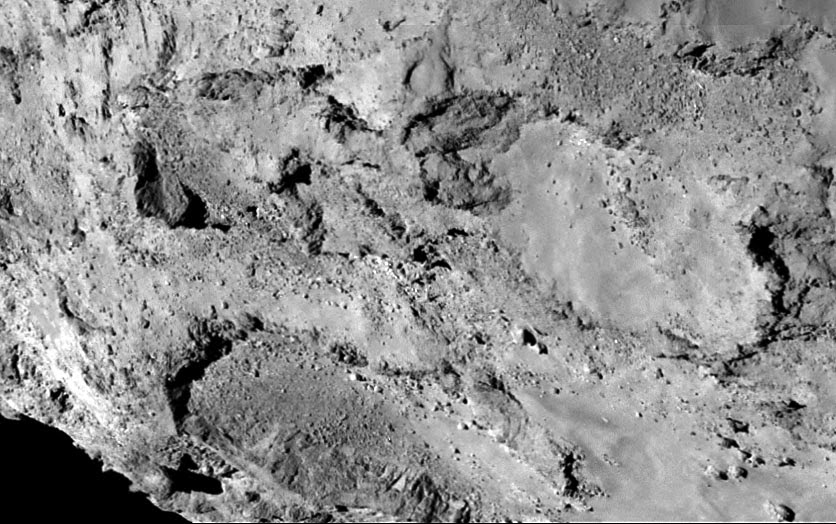
     Images of 67P taken by the spacecraft's OSIRIS camera at the end of July/early August 2014 revealed a heavily cratered nucleus with two distinct lobes, showing house-size boulders strewn across relatively smooth plains and towering, sharply etched cliffs, estimated to be up 500 feet high. See the pictures above.  
   Plans call for Rosetta to enter an actual orbit around 67P on September 10th, after performing a series of manoeuvres with it’s thrusters that will bring it to about 19 miles from the nucleus.
   For the next two months it will conduct a detailed mapping of the surface, as well as  measurements of the comet’s gravity field, mass, shape, and gas from it’s atmosphere, or the developing  coma. Then mission controllers and scientists will choose a landing site for the 200 pound Philae, which is scheduled for November 11th. The gravity on the surface of the comet is so low that Philae will use harpoons that will be shot into the surface so the vehicle will not bounce away into space. 
   The lander will drill into the surface to a depth of about 9 inches and analyze samples in its laboratory. 
   The Rosetta craft will follow 67P/Churyumov–Gerasimenko throughout 2015, after which it’s mission will end and it will self destruct, because we just don’t leave trash in space.
   Why are we doing this? Why do we care about a far away comet that will never interact with the Earth? Why are we spending so much when we have so many problems at home that the money could better be used for.  
   Well don’t you worry about the money. The austerity happy Europeans are footing the bill, not us. And if you’re so worried about cash, why not lobby your representatives in Congress about  removing the cap on income that is currently $106,800. Do that and most of our fiscal problems in the States will be solved. Or how about reigning in the Department of Defense, or at least auditing it. Do we really need a military that’s larger than all other countries combined?
   No.
   Or does the Pentagon really need to give away billions in military equipment to local police departments, rather than selling it as scrap? 
   No.
   In any case, the money we spend in space exploration is miniscule compared to just what the DOD wastes!
   And it’s money well spent. 
   Comets are uncontaminated remnants of the primordial solar system. Their substance are examples of what the Solar System was like when it was born 4.7 billion years ago (sorry Bible people). To study it is to learn of ourselves and our origen.     
   Understanding other planets and astronomical objects helps us to understand the Earth, our home, to a greater degree. Our planet is currently undergoing atmospheric changes that are unprecedented in recorded history, and that will affect humanity for the foreseeable future. Almost every practical aspect of society... population, the environment, economics, and even politics, is and will be increasingly impacted by our relationship with the planet. 
   To understand the cosmos is to understand ourselves. 
    Just as it is of great importance to study and understand our ancient history, by whatever means are available to us, it is also important to attempt to understand what the future may hold. 
   It’s what we know and understand that helps us. It’s what we don’t know that may be our final downfall.

Addendum: 9-29-14: Philae to land November 12th
Addendum: 10-21-14: New image.
Addendum: 10-24-14: Comet dust.
Addendum: 1-22-15: More Surprises
Addendum: 1-22-15: Getting to Know You, Getting to Know All About You
Addendum: 10-28-14: Ambition film.
Addendum: 12-1-14: New Images
Addendum: 12-12-14: Rosetta fuels debate on the origins of Earth's oceans
Addendum: 1-22-15: Another visitor for Comet 67P
Addendum: 4-20-15: Tax Day
Addendum: 7-30-15: Lander shows there's more to comet than soft dust