Tuesday, January 28, 2014

Skid Row Diary 21


26 August  2003   Tuesday   Day 45


   At 7:00AM I tuned into “Despierta America” as is my custom, and Giselle was no where to be found. No dress, no pants... no Giselle! Had my lady expended so much energy and effort into yesterday’s show that she required a spell of R & R to continue on? Well, if she had she deserves all the time necessary to recuperate so she may return to us all rosy and fresh, ready to once again brighten our dreary lives with her special presence.
   But wait! About a half hour into the show the beautiful and talented Jackie Guerrido, the show’s beautiful and talented meteorologist, introduced Giselle who was at a remote location.
   That little scamp had taken a boat, or plane, traveling all the way to Puerto Rico from Miami. She was there to host some outdoor event featuring a variety of acts who sang and danced in Spanish (and it’s not easy to dance in Spanish). She looked wonderful, but was still wearing pants. And she kept kissing on some Latin guy. He looked kind of gay to me so I didn’t get too jealous.
   Just before 9:00 I took my collapsible, heavy duty, $14 dolly to the Service Spot... again. Again McCree wasn’t there. I was told he would be there in a few minutes. In the meantime I was offered a cup of coffee which I accepted. I waited in the small, crowded lobby. One gentleman, who was utilizing the free phone that was available there, heard something over the line that he didn’t like, slammed the phone down and walked out. Another gentleman took his place.
   McCree leisurely strolled in about 10 minutes later, entered, didn’t see me at first, then came over and shook my hand.
   “You been waiting long?” he asked.
   “I’ve been waiting since yesterday,” I told him.
   “I know, I know,” he said, then escorted me into the back of the facility where ordinary people dare not pass.
   He introduced me to several of his co-workers who genuinely displayed no interest in meeting me. Ron told them I was his former boss. I assume he once worked for me at some point back in Pasadena although I have little recollection of that period... which is odd. I remember Ron, but not what we did. Sobriety is not all clean and fluent as it’s cracked up to be.       
   He also introduced me to the freaking huge portable television we were to move. 
   Big and black... just the way I like em.
   At least 50 inches across, and 40 high, weighing approximately 5,000 pounds, we hefted it off of it’s stand and onto my dolly. Ron was all ready to let me handle it from there. After all, it was my dolly.
   “If you think I’m going to push this thing then you seriously need therapy,” I told him.
   “Ahh man,” he whined.
   We shared the load, him taking the first half, I the second, to his small apartment on Boyle St., off of San Pedro.
   It’s like stepping through a portal into a whole different world. 
   Entering his apartment building one leaves behind the noisy squalor of the busy shops and mixture of homeless and people looking for bargains, into a clean, uncluttered quiet atmosphere of a modern residential building. It’s actually a little unnerving.
   I’d been there twice before, and was reintroduced to the building’s manager, a nice, slightly plump, black lady.
   “Long time, no see,” she said.
   “Yes,” I wittily replied.
   Fortunately this building had an elevator, and it was relatively easy to get the monster TV up to the 4th floor and Ron’s room. We placed it on his small refrigerator and took his old one to the dumpster downstairs. 
   I told him I wanted to accompany him on his weekly walk through the neighborhood Saturday morning, and that I’d meet him at his place at 7:00.
   We walked out front, and before I left he hit me up for fifteen cents.
   “You still owe me five bucks!” I said.
   “Why you gotta tell everybody?” he exclaimed.
   I looked around. The only one within earshot was the distracted proprietor of a roach coach.
   “You really think he cares about you’re financial situation?” I asked.
   I realize I can be rather abrasive and insensitive at times. I don’t mean to hurt people though. I chastise myself whenever I remember instances of this type of behavior.
   This wasn’t one of those instances. He did owe me five bucks. $5.15 now.
   “You ever think about going back into the Salvation Army,” he asked me right out of the blue.
   “No,” I told him.
   “How come?”
   “Well, if I had to I’d go back I’d go to the Harbor Light. Never back to an ARC.”
   “Why?”
   “You don’t have to work at Harbor Light. All you really have to do is attend three meetings a day. The rest is rack time.”
   “But I think an ARC prepares you more...”
   “Maybe,” I said. “For those who need that. You don’t. I don’t. Slave labor is what it is. Income generating slave labor utilized toward self perpetuation. I’m not saying that’s a bad thing... for those who need it. I’m just not going to pretty it up by calling it 'work therapy,” that’s all.”
   I though a moment.
   “Besides I’m banned from the ARCs”
   “Banned?”
   “Yes.”
   “What for?”
   It’s very rare that Ron asks questions about people. Usually walking around with him is like listening to an unending loop concerning only things that have happened to Ron.
   “I’ve never told you this before?”
   “No.”
   “I was banned after writing a nasty letter to the administrator of the Carpinteria ARC in responce to being thrown out of there for having sexual relations with one of the psychology interns, and her getting pregnant.”
   “What?!”
   “Yeah. Not only did they throw me out, they let her go to, and discredited her.” 
   It’s true. Her name was Julie and she had been my individual counselor. She was a pretty student of psychology doing her intern time at the Carp ARC, and I was a beneficiary... again, working behind the resident desk... again. 
   I had left Pasadena under less than favorable circumstances. Robert Vasquez and I had exchanged Jobs, with me being the resident manager and him my assistant. The powers that be thought that would be a good idea because they thought Robert might retire soon, and they thought I might be easier to work with than Robert... more flexible is how they put it. They were wrong.
   Anyway we got a new administrator in the form of a Capt. Ron Strickland and his lovely wife Pamela. Reuben Smith became a deskman, and worked for me. And we got a new program director, Steve somebody, I don’t remember his last name. Some middle aged white guy from Hawaii. 
   I did a great job, if I don’t say so myself. Robert was so gracious during this change, it was unbelievable. However I kept bugging the administration about having fire drills, and keeping emergency supplies on hand, I guess I was a pain in the ass for them to a degree. And I was perhaps a little too friendly towards Pamela than I should have been. 
   Reuben got resentful of my authority over him, and got all serious all of the time. No more fun loving Reuben. Steve wanted me gone as well for some reason, and they both colluded in busting me smoking cigarettes up in the sample room. Strickland suspended me, at which point I promptly relapsed and wound up leaving the ARC, headed back to the Canoga Park ARC at first, then up north to Carpinteria, where I met Julie.
   We were about the same age. She was married and had two children, an older daughter and a young son. Unbeknownst to me, and maybe her husband, she got tired of playing the stay at home mom, her kids being old enough at the time to pretty much take care of themselves, and she wanted to seek adventure and meaning outside of the home, and I became part of that.
   I had given her a copy of Salvation Diary which she actually read. She seemed to like it a lot, but by her reading it she got to know a lot about me, and I guess felt closer to me because of it. 
   One time during our weekly session she told me she was going to ask to have me transfered to another counselor. I was suitably upset as she was certainly the prettiest counselor currently working at the ARC, and prone to wearing miniskirts.     
   “Why are you going to do that?” I asked her.
   “Because I find you attractive.”
   “Oh, that doen’t matter. I find you attractive as well.”
   I got her to meet me outside of the ARC after the session and we drove to a nearby beach in her car to get to know each other, and an affair ensued. 
   I’m not doubting her sincerity in telling me she found me attractive... many women do. It’s a curse I’ve suffered with all of my life. Still, she pretty much used me to help end her 19 year marriage, and things got quite sticky at times. And like many drug and alcohol interns she was a drama queen, bi-polar maniac with an eating disorder.
   Some of the most depressing times I’ve ever experienced were while I was with her, yet one thing led to another and she became pregnant. By that time I did have a different individual counselor, who I unwisely told the story of Julie and me. You see counselors are bound by law and ethics not to disclose matters of confidence to anybody else, sort of like the relationship a priest, or lawyer have with their clients. 
   I suppose my new counselor didn’t know about that because she blabbed all about it to the program director, who talked to me. Now he was also bound by law and ethics not to divulge anything that he and I talked about, or that my counselor and I had talked about. The next thing I knew he called me into his office and told me, “I told the Captain.”
   “You what?! Why? You said you wouldn’t!”
   “I felt I just had to.”
   He felt he just had to.
   His feeling got me thrown out of the ARC and on to the streets of Carpinteria. His feeling cost Julie her internship, and threatened her future career as a drug and alcohol counselor.
   It was a long and wicked journey for both of us after that. She stayed in the Ventura area, eventually leaving her husband and becoming a drug and alcohol counselor. I wound up living in nearby Camarillo, working for a company called Emergency Road Service, which provided... emergency road service to drivers who needed emergency road service across the nation. I didn’t go out and change people’s tires or anything. It was more of a phone, customer service job, taking requests for emergency road service, verifying what type of coverage these people had, and then dispatching local help to them. It was a good job. I liked it.
   Anyway, I relapsed, lost that job, moved to Bullhead City for a year, becoming a ATM technician with a paper route in the mornings. Then back to L.A. where I eventually took a bus downtown after watching the first “Lord of the Rings” movie, all drunk, and checked into the Salvation Army’s Harbor Light facility on 5th Street and Central. I spent a year there before coming to the Weingart, and the rest, as they say, is history.
   I hadn’t seen Julie for a few years.
   “Man, I thought I knew all about you,” Ron said.
   “You did?”
   “So, did she have the baby?”
   “No. No she did not.”
   I though a moment more.
   “We’re too old for these programs, Ron. We should be able to figure out how to lick any of these problems that come up. Especially you, you old geeze. You’ve got to get some kind of life going on before you hit the boneyard.”
   See what I mean about being insensitive. I’m much nicer to people I don’t know. I don’t know what my problem is. Redirection perhaps. Probably that’s what it is. I take others inventory so I don’t have to take my own.
   Well that’s being human at least, and can be worked on.
   We shook hands and separated. I returned to my room and watched “Heartbreakers,” on my VCR machine. The movie, starring Jennifer Love Hewitt and Sigourney Weaver, can boost Gene Hackman’s worst part ever. Not his worst performance, he’s good in everything, but his least interesting and most contrived role.
   But Jennifer was great!
   I took a little nap and dreamt I was the co-weather person on Despierta America, along with the lovely Jackie Guerrido. The only problem was that I could only speak Gaelic, which was unsuitable for a Spanish language program.
   Fortunately Jackie is half Irish and was able to translate for me.
   When I woke I continued writing while listening to NPR.
   Later in the evening I watched an interesting story concerning the creation of the transistor in 1947, by  John Bardeen, Walter Brattain, and William Shockley, of Bell Laboratories. 
   How exciting!
   I went to sleep soon after and dreamt of driving through the lush green hills west of Atascadero, California, with my beautiful and talented friend Julie, while listening to Moby on her tape deck. We were on our way to see the walruses on the beach just south of San Simeon. We talked about living in Europe.


27  August   Wednesday   Day 46


   At 5:27:13 I felt pulled to the southeast. I lazily assumed this disturbance was caused by the gravitational pull of Mars as it came within 34,646,418 miles of the Earth. At 5:27:14 the red planet began to recede, or rather, continued on it’s orbit furthering the distance between itself and its closest planetary neighbor. At 5:27:35 I experienced enlightenment and went back to sleep and to Julie.
   Many wish to know what it feels like to experience Satori (a Japanese Buddhist term for awakening, "comprehension; understanding." In the Zen Buddhist tradition, satori refers to the experience of kenshō, "seeing into one's true nature". Ken means "seeing," shō means "nature" or "essence), or enlightenment, and what happens. Well, it’s difficult to put into words, but other than being open to space and time, with an all encompassing  deep understanding of the universe and beyond, there isn’t much to it.
   I woke up later and turned my TV on to Despierta America. Giselle was busy interviewing a gentleman about the Mars occlusion. I knew this because I am now party to the all encompassing knowledge of the universe... and beyond, so even though they were speaking in Spanish, which I haven’t decided to learn yet, I knew what they were saying. 
   The picture of Mars was a clue as well.
   I needed to go to Trimar today, so I got up, showered, had a tuna sandwich for breakfast, and took off. 
   I stopped at the 99 Cent Store on the way and picked up a nice can of tamales, another can of spaghetti and meatballs, tea and coffee, plastic zipper lock bags, shampoo, 2 blank VCR tapes, and 2 blank audio tapes. And smoked sausage and German bologna. I couldn’t find any  microwave popcorn.  I couldn’t sense any in the store at least.
   The silly movie “Kate and Leopold,” starring Meg Ryan and Wolverine was on when I entered the plasma center. The film is silly because it states that one must jump off of a bridge in New York in order to travel back and forth in time. How absurd. It’s much easier then that. Anybody can travel back and forth in time without going through all of that trouble. 
   I was down to 182 pounds, which is about my ideal weight. I’ve been fluctuating recently due to my erratic eating habits, and the cold I was just getting over.
   My pulse was quite high, 92.
   “Kate and Leopold,” was followed by the equally silly “Men in Black II,” starring the lovely and talented Rosario Dawson. 
   The film is silly because it postulates that extraterrestrials are visiting the Earth all of the time, which is just silly. Aliens don’t visit our planet all of the time. They’ve got more important things to do. 
   Aurica was at work today, but did not have time to stop and chat. 
   I left the plasma center just as the bus arrived across busy Vanowen Street. I ran across the street to try and catch it, but it pulled away as I approached the door. I could see the driver through the rear view mirror chuckling to himself in a haphazard manner. 
   I cursed him vehemently.
   I then felt achy and tired, and wanted to return to the Weingart as quickly as possible.
   I read from King’s book of short stories until the next bus came. "The Road Virus Heads North."   
   You know what I’d do if that road virus bastard was after me? I’d beat the holy shit out of him with a big stick. 
   True to form the 156 bus was just leaving as I arrived at the intersection of Van Nuys and Vanowen. 
   However, the MTA made a mistake, and another 156 came right after the one that had just left, which I jumped on.
   Ha ha on you, MTA.
   I made pretty good time getting back, arriving just as dinner was being served. Dressed turkey.
   I was exhausted by the time I reached my room. Enlightenment must be quite taxing initially. I remembered almost fainting after standing up quickly when getting paid at Trimar. I sat on my bed and relaxed. “Married with Children,” had been preempted again, by some police pursuit of someone driving a van.
   I sure don’t understand the appeal of these televised car chases. Sometimes they last for hours, for a couple of times a week here in L.A. What we have here is basically a helicopter photographing a car driving around. I can look outside of my window and see the same thing. Granted the promise of some drama is involved. Perhaps the pursued vehicle will hit some other cars or pedestrians. And we all feel pretty good that it’s not us the cops are after. Maybe something interesting will transpire at the inevitable conclusion. Usually however, the driver just gets tackled by an overwhelming amount of police thugs... I mean officers.
   I tend to root for the underdog in most situations, so unless the perpetrator has done something heinous,  or hurt someone, I like it when they get away, which rarely happens.    
   All these drivers have to do really is get a little ahead of the police, drive to a mall, jump out and blend in with the crowd. 
   I read that in a Tom Clancy novel somewhere. 
   I had an incredible craving for cigarettes this evening. I don’t know why. The cravings left after I ignored them. 
   I was too tired to do anything other than watching a repeat episode of Charley Rose with the enigmatic Annie Lennox, that I’d seen before. And “The Simpsons,”  a brand new show with Marisa Tomei and James L. Brooks. Marisa wound up getting married to Bob Balaban of all people, second only to Woody Allen as a renowned lover.
   I fell asleep after 9:00, and dreamt I was welcomed to Nirvana upon the slopes of Olympus  Mons on Mars, the largest volcano in the solar system. The Queen of Space, Tori Spelling, welcomed me, along with her consorts,  Alicyn Sterling and Bianca Trump, stars of “Shattered,” and “Maid Service,” respectively. Tori was dressed in her space bikini.
   “Welcome, lonely space wanderer!” she shouted out. “Come with us into the halls of yonder enclave, and we shall greet you with food, drink, and merriment.”
   The girls picked me up and carried me into the mountain, and I was never heard from again.

Sunday, January 26, 2014

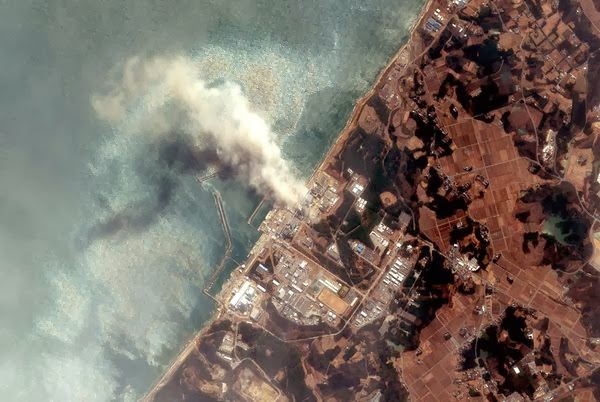
An Incident at Fukushima Daiichi, Part 6, Meltdown


Picture Legend
1. Fukushima Daini
2. Fukushima Daini overhead
3. Explosion at Fukushima Daiichi
4. Fukushima Daiichi schematic
5. GE boiling water reactors (BWR) cutaway
6. Satellite view
7. What you’re looking at
8. Another satellite view
9. Reactor 4 building
10. International Nuclear Event Scale
11. Debris field
12. Fuel rods in storage pool at reactor 4
13. Severn


   A call by the Japanese government to evacuate certain areas adjacent to the Fukushima Daiichi Nuclear Power plant went out at 10:00PM on the night of March 11, 2011. 134,000 people were sent out of the area within 2 miles of the plant, which the government designated a “prohibited access area.” 2 miles to 12.5 miles was designated an “on alert area,” and from 12.5 to 19 miles an “evacuation prepared area.” Those residing within the “on alert area” were told to stay indoors.
   The Tokyo Electric Power Company (TEPCO) announced that the pressure inside reactor 1 was more than twice normal levels at this time. 
   At Fukushima Daini, 10 miles to the south of the  Daiichi plant, a tsunami generated 30 foot wave had breached it’s protective seawall causing the coolant pumps to fail for the plant’s four reactors (the reactors had shut down automatically after the 9.0 earthquake had struck, yet still required coolant water to dissipate residual heat). Because the earthquake occurred during the working day (2:46PM on a Friday afternoon), 2,000 employees were on site to help stabilize whatever situations arose. As 3 of the 4 reactors began to overheat due to lack of coolant, employees worked to move 650 foot sections of cable, each weighing over a ton, a distance of over 5.5 miles, in order to power emergency cooling systems.   
   An evacuation order was issued to the people living within 2 miles of the plant.   
   One seawater coolant pump remained operational in reactor 3. The residual heat removal system (RHR) was started to cool the suppression pool (the suppression pool is used to remove heat released if an event occurs in which large quantities of steam are released from the reactor or the reactor recirculation system), which made it possible to bring the reactor to a cold shutdown the next day.
   Heat removal was not available for reactors 1, 2, and 4, so their suppression pools began to heat up to over 212 degrees Fahrenheit between 5:30 and 6:10PM. This heat build up removed the ability of the operators to relieve pressure from the affected reactors.
   Back at Fukushima Daiichi the clock ticked past midnight into Saturday, March 12th. Hydrogen gas began to accumulate in reactors 1, 2, and 3 due to overheating causing a reaction between the coolant water and the zircalloy (solid solutions of the element zirconium, used as the outer layer of the fuel rods, standing between the coolant and the nuclear fuel). 
   Emergency battery power for reactor 3‘s  high pressure core-flooder system (a system used  inject water into the core to cool it and reduce reactor pressure) failed. About two hours later, at approximately 4:15AM, the fuel rods in 3 were exposed.
   Due to a build up of pressure in reactor 1, the decision was made to vent off some of the steam despite the possibility of an explosion as the hydrogen gas combined with oxygen in the atmosphere. This was the first radiation leak into the environment. .
   Fresh water was injected into reactor 1, but it did not stop the core from melting completely, and falling to the bottom of the reactor pressure vessel. 
   Radioactive water vapor was released into the atmosphere from reactor 2 due to high pressure.
   Due to accumulated hydrogen gas a large explosion occurred at 3:36PM in the outer structure of reactor 1, causing the collapse of the concrete building housing the reactor. Operators believe the actual reactor however, was not damaged, and seawater was subsequently injected into it. 
   Later that night the evacuation zone around Fukushima I was extended out to 12.5 miles, and 6 miles around Fukushima II. 
   At 5:10AM, March 13th, Fukushima Daiichi’s reactor 1 was declared an INES (International Nuclear Event Scale) Level-4 "accident with local consequences" event.
   At Fukushima Daini the service seawater system pumps were repaired in reactors 1, 2 and 4,  and cooling was switched back to the residual heat removal system. When the suppression pool was cooled to below 212 degrees F, the RHR was switched to the shutdown cooling mode which  brought the reactors to a cold shutdown. The loss of cooling water at reactors 1, 2 and 4 was classified a level 3 on the INES (serious incident) by Japanese authorities on March 18th. 
   By the 15th all four reactors of Fukushima Daini had reached cold shutdown, and were considered   non-threatening
   This was not the case at  Fukushima Daiichi. On March 14th, a similar explosion to reactor 1 occurred in the reactor 3 building, blowing off the roof and injuring eleven people. On the 15th, an explosion in the reactor 2 building damaged it and part of the reactor 4 building.
   Damage to the temporary cooling systems on reactor 2 from the explosion in reactor 3, plus problems with its venting system, meant that water could not be added causing reactor 2 to be in the worst shape of the three reactors at that time. An explosion in the "pressure suppression room" caused some damage to reactor 2’s containment system. A fire broke out at reactor 4. Radiation levels at the plant rose significantly but subsequently fell. Radiation equivalent dose rates of 400 millisieverts per hour (a sievert is a derived metric unit of equivalent radiation dose (a computed average measure of the radiation absorbed by a fixed mass of biological tissue, that attempts to account for the different biological damage potential of different types of ionizing radiation), effective dose (a measure of the cancer risk to a whole organism due to ionizing radiation), and committed dose (a measure of the probabilistic health effect on an individual due to an intake of radioactive material into their body). A milliSievert is one thousandth of a sievert. The average annual radiation dose per person in the U.S. by natural causes is 6.2 millisieverts per year)) were observed at one location in the reactor of unit 3.
   On and on. 
   I’m almost positive, dear readers, why the disaster at Fukushima Daiichi has been considered the most complicated in history. Three reactors meltdown within close proximity of each other (plus a loaded spent fuel pool in reactor building 4), all influencing each other in different and varied disastrous ways. 
   Since March 11th a continuous battle has ensued with plant workers fighting fires and radiation leaks into the atmosphere and Pacific Ocean. Water has been injected into each of the three reactor units more or less continuously. This water becomes contaminated and either boils off, is removed, stored and processed, or leaks into the environment. 
   There was a peak of radioactive release on Tuesday, the 15th, apparently from reactor 2, but the precise source remains uncertain. Venting and hydrogen explosions discharged a goodly amount  of radioactive material into the atmosphere, notably iodine and caesium. Japan’s Nuclear and Industrial Safety Agency (NISA) said in June that it estimated that 800-1000 kilograms (1763.7 to 2204.62 pounds) of hydrogen had been produced in each of the units. Nitrogen was injected into the containment vessels of all three reactors to remove concerns about further hydrogen explosions, and in December this was done for the pressure vessels as well. Gas control systems which extract and clean the gas from the primary containment vessel to avoid leakage of caesium were commissioned for all three units.
   On and on.
   On Thursday, March 24th, after radioactive water seeped through their protective clothes, three plant workers were exposed to high levels of radiation which caused two of them to require hospital treatment. The workers were exposed to an estimated equivalent dose of 2 to 6 sieverts to the skin below their ankles. They were not wearing protective boots as their employer’s safety manuals "did not assume a scenario in which its employees would carry out work standing in water at a nuclear power plant."      
   The U.S. Navy sent a barge with 500,000 gallons of fresh water to the affected area. Tap water was reported to be safe for infants in Tokyo and Chiba by Japanese authorities (how about adults?), but still exceeded limits in the cities of Hitachi and Tokaimura. Iodine-131 in the ocean near the plant measured 50,000 becquerels (one becquerel is defined as the activity of a quantity of radioactive material in which one nucleus decays per second), 1,250 times the normal level.     High radiation levels caused delays for technicians working to restore the water cooling systems for the reactors. The Japanese Nuclear Safety Commission stated that it "assumed" melted fuel rods in reactor 2 had released radioactive substances into the coolant water, which subsequently leaked out through an unknown route to the unit 2 turbine building basement. Accordingly, in order to reduce the amount of leaking water, TEPCO reduced the amount of water pumped into  reactor 2, from 16 tons per hour to 7 tons per hour, which of course would then lead to a higher reactor temperature.
   On and on.
   And on Wednesday, March 30th, TEPCO Chairman Tsunehisa Katsumata announced at a news conference that it was unclear how the problems at the plant would be resolved. He cited an immediate difficulty was the removal of large quantities of radioactive water in the basement buildings, and also mentioned salt build up inside the reactors, there from using seawater for cooling, (hence the fresh water brought by the U.S. Navy) which needed to be removed. Building a concrete enclosure for the reactors as a containment structure, as had been done at Chernobyl, was considered. 
   The Environmental Protection Agency (EPA) found radioactive iodine in milk in the United States.
   On and on.
   On Saturday, April 2nd, TEPCO observed for the first time that contaminated water from reactor 2 was flowing into the sea. The workers discovered a crack about 8 inches wide in a maintenance pit, which lied between the reactor and the sea. They attempted to plug the leak with cement, but the concrete would not set. TEPCO then attempted to plug up the trench that led to the damaged storage pit with a combination of superabsorbent polymer, sawdust and shredded newspaper. That also failed. Radioactive water continued to leak into the sea.
   Besides the leaks, contaminated water was intentionally dumped into the ocean. TEPCO began dumping water (up to 11,500 tons of it) from storage tanks contaminated with low levels of radioactivity into the sea on April 4th. Officials stated this was needed to make room in a central waste facility to store water with a higher radioactive level. This more highly radioactive water was preventing workers from making progress on restoring the cooling and other systems to the reactors. Samples of seawater near the plant revealed radioactive caesium at 1.1 million times the legal limit.
   On and on and on.
   Wednesday, April 6th, despite protests from South Korea, Russian scientists, and Japanese fishermen, Japanese authorities authorized the release of 12,700 tons of less radioactive water into the ocean to make room for water that was highly contaminated. Iodine-131 levels reach 7.5 million times the legal limit in a seawater sample taken near the plant.  
   On Monday, April 11th, a 7.1 magnitude earthquake struck the region around Fukushima Daiichi causing coolant injection into reactors 1 and 3 to stop for 50 minutes due to a loss of power.
   The next day Japan officially raised Fukushima to INES Level 7, the same as Chernobyl.   Approximately 10 times the amount of radiation was released into the atmosphere at Chernobyl,  as was released from Fukushima I through April 12th, 2011. Fukushima still stores approximately 8 times the amount of radioactive material that was stored at Chernobyl, and the leakage continues.
   Officials now estimate that it could take up to 40 years to clean up and decommission the reactors at Fukushima I.
   On October 12, 2012, TEPCO admitted that it had failed to take stronger measures to prevent disasters for fear of inviting lawsuits or protests against its nuclear operations.
   On March 12th, 2011, radioactive releases first reached a Comprehensive Nuclear-Test-Ban Treaty Organization (CTBTO) monitoring station in Takasaki, Japan, around 124 miles away from Fukushima I. Radioactive isotopes appeared in eastern Russia on March 14th, and the west coast of the United States by the 16th. By the 26th, traces of radioactivity were detectable all across the northern hemisphere. Within one month, radioactive particles were detected by CTBTO stations in the southern hemisphere.

   January 19th, 2014, Petaluma, Northern California. John Bertucci, a film maker by profession, carries a Geiger counter wherever he goes. “I'm still learning how to use the device but it gives me peace of mind to know that I can do something to inform and protect myself.” Mr. Bertucci is one of the founders of  Fukushima Response, a small group of people in the area who collect and distribute information about the incident at Fukushima Daiichi. "Japan is thousands of miles from the California coast but there are indicators that the radiation is reaching California.”
   Health officials in the Canadian province of British Columbia are cautioning residents not to  ingest large doses of potassium iodide in order to offset the effects of radioactive contamination from Fukushima. The thyroid can only absorb so much iodine, and the British Columbians are right in thinking that if they fill up with a benign form of iodine, then deadly radioactive isotopes like iodine-131 have no where to go. Still,  experts say ingesting these pills are unnecessary and could  lead to dangerous overdoses. The Health Physics Society states on their website that potassium iodine “has been erroneously represented as a ‘magic bullet’ of radiation protection.” If taken properly, it only protects against internal radiation from radioiodine taken into the body, it will not protect against external radiation or internal radiation from radionuclides other than radioiodine,” and even then will only affect the thyroid from any radiation-induced effects... yet calls for large quantities of the compound by citizens persist. 
   As of last November an enormous debris field originating from Fukushima the size of Texas is floating 1,700 miles off the Pacific coast, located between Hawaii and Santa Monica, California. It is estimated that this field contains 1.5 million tons of objects ranging from little particles, to intact boats, to entire docks, and everything in-between. The National Oceanic and Atmospheric Administration (NOAA) estimates that the trash overall is scattered across an area in the ocean about three times the size of the continental United States.
   Back in Petaluma John Bertucci  and others at Fukushima Response say that they are not convinced that the Environmental Protection Agency, is doing all it can to monitor radiation levels. Additionally no U.S. government agency has monitored radiation levels in the ocean water.
   The EPA monitors radiation levels in air, drinking water, rain, and pasteurized milk, but not ocean water as that is not generally consumable by the public. Still, the “E” in EPA stands for environment, and the ocean is part of the environment.
   Their air monitoring system, called RadNet, consists of 132 stationary monitors spread throughout the U.S. The monitoring stations continuously read radiation levels and report abnormal radiation readings back to the EPA’s scientists. At least that’s how it’s supposed to work.
   Radiation monitoring experts and activists says that the RadNet system is inadequate and can't protect the public in case of a major nuclear disaster if something goes wrong at one of the 104 U.S. nuclear reactors or if there are additional explosions at Fukushima I. 
   You would think the Obama administration would want to be on top of this situation. Yet some speculate there may be reasons why the government might want to play down concerns about possible contamination of the United States by the reactors at Fukushima.
   Back in 1972, Stephen H. Hanauer, a safety official with the Atomic Energy Commission, recommended that the Mark 1 Boiling Water Reactor (BWR) system be discontinued because it presented unacceptable safety risks. Among the concerns he cited were the smaller containment design for the reactor, which made them more susceptible to explosions and ruptures from a buildup of hydrogen gas, a situation that later manifested itself at Fukushima Daiichi. But at that time the reactors had been so accepted by the nuclear power industry that it was virtually impossible to stop their use. Three years later, nuclear engineer Dale Bridenbaugh and two colleagues (later known as the GE 3) were asked to review the Mark 1 BWR. They became convinced that this type of reactor was inherently unsafe and so flawed in its design that it could  fail, with catastrophic consequences, under certain circumstances. They cited two issues. First was the possible failure of the Mark 1 to deal with the huge pressures created if the unit lost cooling power, and secondly, the spent fuel ponds were situated 100 feet in the air near the top of the reactor.
     Five of the six reactors at Fukushima I were General Electric Mark 1 BWRs. The first reactor, unit one, was commissioned in 1971, before the first concerns about the design was raised. The other reactors came on line in 1973, 1974, 1977, 1978 and 1979 respectively. Although all six reactors were the GE Mark 1 design only three were built and supplied by GE, reactors 1, 2 and 6. 3 and 5 were built by the Japanese company Toshiba, and unit 4 by Hitachi (now Hitachi-GE Nuclear Energy, Ltd., established in June of 2007).
   Under Japanese law GE, Toshiba, and Hitachi cannot be held liable for accidents at nuclear power facilities. 
   Here in the U.S. there are 23 nuclear power plants that use the GE Mark 1 BWR. There are also 23 nuclear power plants in the U.S. where used fuel rods are suspended, in a pond, 100 feet above the ground.
   Jeffery Immelt is the chairman of the board and chief executive officer of General Electric. He is also the head of the United States Economic Advisory Board, invited to that position personally by President Obama in 2009, taking over as head in 2011, just a month before the disaster at Fukushima.
   One possible theory for an apparent indifference to the emergency in Japan is that any admission that radiation from a GE designed reactor has spread across the Pacific Ocean and contaminated American soil is an admission that the original technology was flawed, and that flawed technology is still being used in the United States. So rather than disrupt an entire industry it’s better to maintain that radiation levels are safe, and there’s nothing to worry about. 
   Is this idea cynical in any way? Yes, and delightedly so!
   If the incident at Fukushima Daiichi has been met with relative indifference here in the United States, it is not the case in many other countries. Germany decommissioned its older nuclear  reactors and will phase the rest out by 2022. Italian citizens voted 94 percent against the government’s plan to build new reactors, as did Switzerland and Belgium. A pro-nuclear government in France was disposed by it’s citizens, and replaced by a new government promising to reduce reliance on nuclear power. Plans to go nuclear were abandoned in Malaysia, the Philippines, Kuwait and Bahrain. China has radically slowed it’s nuclear program. Iran has promised it’s nuclear capabilities will only be used to make weapons.   
   Or only for peaceful purposes, I forget which.
   Journalist and advocate for renewable energy, Harvey Wasserman, and others, have called for an international response to the ongoing crisis at Fukushima Daiichi, citing the inability of TEPCO and the Japanese government to deal effectively with the situation, which may get decidedly worse in the future if certain events occur, like another major earthquake. He, and I, are especially worried about the spent fuel rods of reactor 4 which need to be removed. 
   Our lovely friend Severn Cullis-Suzuki, is the daughter of the famous environmental activist David Suzuki who in the clip above postulates that if something were to occur, some accident releasing those fuel rods at reactor 4 into the atmosphere, then we might as well evacuate the west coast of the United States due to radiation contamination. He has since stated that he regrets making that wide conjecture.
   But I don’t like to take chances. I happen to live on the west coast of the United States and don’t want to evacuate. Where would I go? Freaking Arizona? Live with my sister? Well screw that!
   The official line from the Japanese government is that the situation is under control.
   “The government is moving to the forefront and we will completely resolve the matter,” said Prime Minister Shinzo Abe last September, just before Tokyo was awarded the 2020 Summer Olympic games.
   But others aren’t so sure.
   “I think this is an ongoing crisis,” said David McNeill, a journalist who has lived in Japan since 2000 and has been covering the Fukushima disaster from the beginning. “What you’ve had is a series of ad hoc strategies designed to deal with the crisis that’s right in front of you.”
   The incident at  Fukushima Daiichi has global consequences and requires a global response. The situation must be dealt with as seriously as the problem is serious... and the sooner the better.

Radioactive cows and the man who wants to save them

Fukushima update, February 24th 2014 here

Update February 28th 2014, "Stunning New Report on USS Reagon Radiation here.

Update March 1 2014, Japanese government wants to restart dormant nuclear reactors, here.

Update May 23 2014, here.

Update June 22 2014, here.

Update July 13 2014, here.

Addendum: 9-1-14: Waste.
Addendum 10-24-14: Radiation approaching U.S. west coast.
Addendum: 2-17-15: U.S. Sailors seek Justice
Addendum: 2-18-15: Leaks continue into oceanEntire Pacific Ocean Contaminated
Addendum: 2-25-15: Cancer rates sore 6000%
Addendum: 3-17-15: Fallout found in Japanese exported tea
Addendum: 3-26-15: Year 5
Addendum: 3-29-15: 36 years of lies
Addendum: 7-1-17: Japan plans to dump contaminated water into the Pacific
Addendum 7-26-18 Radioactivity found in California Wines

Wednesday, January 22, 2014

An Incident at Fukushima Daiichi, Part 5, The Incident


Picture Legend
1. Chernobyl afterwards
2. Map of the Japanese nuclear plants in the Sendai region
3. Simplified cross-section sketch of a typical BWR Mark I containment as used in reactors 1 though 5.
Key:
RPV: reactor pressure vessel.
DW: dry well enclosing reactor pressure vessel.
WW: wet well - torus-shaped all around the base enclosing steam suppression pool. Excess steam from the dry well enters the wet well water pool via downcomer pipes.
SFP: spent fuel pool area.
SCSW: secondary concrete shield wall.


April 26th, 1986    Ukrainian Soviet Socialist Republic


   The engineers had began the gradual power down procedure the day before. 
   What was going to be tested was the ability to generate enough power to sustain cooling to a reactor after an emergency shut down when normal sources had been made unavailable. As we discovered in the last post, in an initial shut-down state a reactor produces approximately 7 percent of its total heat output and cooling is still required to avoid core damage. Cooling pumps require electricity to pump water through the reactor. What was being tested were ways to make up for a discrepancy  in the amount of time it took for emergency generators to start and the time it took them to get to full speed, or power output, which was about 60 to 75 seconds. 
   The test began with an automatic emergency shutdown. According to test protocol the reactor’s thermal output should have been no lower than 700 megawatts. Accordingly no detrimental effects on the safety of the reactor were anticipated, so the test program was not formally coordinated with either the chief designers of the reactor, or the scientific manager. Instead, it was approved only by the director of the plant (and even this approval was not consistent with established procedures).
   The experiment began at 1:23:04 Moscow Time. The steam to the turbines was shut off, beginning a run-down of the turbine generator. The water flow rate through the reactor decreased, leading to increased formation of steam voids (bubbles) in the core. This formation of steam voids reduced the ability of the liquid water coolant to absorb neutrons, which in turn increased the reactor's power output. This caused yet more water to flash into steam, causing yet a further power increase. Inserting control rods into the core counteracted this energy increase, however the system being used had control of only 12 rods, the rest having already been removed manually. 
   It is believed that at 1:23:40 the EPS-5 button was manually pressed in what was probably a response to the core’s power increase. The pressing of the EPS-5 button (or else the initiation of automatic emergency procedures) caused a SCRAM (“safety cut rope axe man” I know, it’s weird, yet the term is believed to have been coined by physicist Enrico Fermi, the designer and builder of the first nuclear reactor, which happened to be located under the bleachers Stagg Field at the University of Chicago, and a precursor to the first atomic bombs) emergency reactor shut down, which engaged the drive mechanism to fully insert all of the control rods, including the manual rods that had been withdrawn earlier. A few seconds after the start of the SCRAM, the graphite control rod tips entered the core. A massive power spike occurred, and the core overheated, causing some of the fuel rods to fail, blocking the control rod columns and jamming the control rods at one-third insertion, with the graphite tips in the middle of the core. Within three seconds the reactor output rose above 530 megawatts.  The power spike caused an increase in fuel temperature and massive steam buildup. The reactor jumped to approximately 30,000 megawatt thermal, ten times the normal operational output. This caused a steam explosion which destroyed the reactor’s casing,  tearing off and lifting a 2,000-ton upper steel plate, to which the entire reactor assembly was attached, sending it flying through the roof of the reactor building. A second, more powerful explosion occurred about two or three seconds after the first; which dispersed the damaged reactor core, ejecting super heated lumps of the graphite moderator (carbon used as a neutron moderator). The ejected graphite and the demolished channels still in the remains of the reactor vessel caught fire on exposure to air, which heavily contributed to the spread of radioactive fallout and external contamination. 
   The citizens of the nearby city of Pripyat were not informed of the accident.  Within a few hours after the explosion, dozens of people fell ill, suffering headaches, and uncontrollable coughing and vomiting. The general Russian (at the time it was still the Soviet Union) population was not informed of the accident until April 28th, two days after the explosion. They were informed via a 20 second announcement on the evening news. Only after rising radiation levels set off alarms at the Forsmark Nuclear Power Plant in Sweden, over 600 miles west of the Chernobyl Plant, did the Soviet Union admit that an accident had occurred.  

   “There has been an accident at the Chernobyl Nuclear Power Plant. One of the nuclear reactors was damaged. The effects of the accident are being remedied. Assistance has been provided for any affected people. An investigative commission has been set up."
—Vremya (the main evening newscast in Russia), 28 April 1986 (9:00PM)

   Four hundred times more radioactive material was ejected from Chernobyl than by the atomic bombing of Hiroshima, Japan. The accident released a total of one hundredth to one thousandth of the entire amount of radioactivity released by nuclear weapons testing during the 1950s and 1960s. About 38,610 square miles of land were significantly contaminated with fallout, the worst hit regions being in Belarus, Ukraine and Russia. Slighter levels of contamination were detected   over all of Europe, except for the Iberian Peninsula (a peninsula located in the extreme southwest of Europe that includes the  sovereign states of Spain, Portugal, Andorra, part of France, as well as the British Overseas Territory of Gibraltar).
    Some 135,000 people were evacuated from the area, including 50,000 from the city of Pripyat.
   After the explosion 237 people suffered from acute radiation sickness (ARS), of whom 31 died within the first three months.  Most of these were fire and rescue workers trying to bring the accident under control, and who were not aware of, or informed of, the latent  exposure to radiation such work would expose them to.  
   Isotopes of iodine (Iodine-131), caesium (Caesium-137) and strontium are responsible for most of the radiation exposure faced by the general population. 
   It was estimated that cancer deaths caused by Chernobyl could reach a total of 4,000 among the 5 million persons residing in the contaminated areas.
   Reactor No. 4  at Chernobyl is now encased in a large concrete sarcophagus, which was built quickly to allow continuing operation of the other reactors at the plant.
   After the explosion the other three reactors continued to operate. In 1991, Reactor No. 2 suffered a major fire, and was subsequently decommissioned. In November of 1996, Reactor No. 1 was shut down, followed by Reactor No. 3 on December 15, in 2000. The entire plant is now closed.
    It is likely that with no further decontamination efforts the gamma ray dosage at the site will return to background levels in about 300 years.
   The explosion at Chernobyl was the first level 7 event (the maximum classification) on the International Nuclear Event Scale, and is considered the worst nuclear accident ever.  
   There’s only been two level 7 events in the history of the nuclear power industry, the other being the ongoing incident at Fukushima Daiichi. Although not considered the worst nuclear accident in history (it  has been considered the second worst), Fukushima Daiichi has been considered the most complicated.
   But please keep in mind... the accident at Fukushima Daiichi is ongoing.

   On the Monday before the accident, March 7th, Tokyo Electric Power Company (TEPCO) submitted a report to Japanese nuclear safety officials which predicted the possibility of a tsunami reaching up to 34 feet at the Fukushima Daiichi nuclear facility in the event of a 7.2 magnitude earthquake similar to the Sanriku earthquake of 1896. TEPCO had actually made the prediction 3 years earlier, but had not felt the need to take immediate action. Considering the seawall surrounding the plant that was designed to protect it from such tsunami’s was only 19 feet high, one has to wonder about the quality of their judgment.
   When the March 11, 2011, 9.0 earthquake struck at 2:46 in the afternoon, reactors 1, 2 and 3 were operating at Fukushima Daiichi, but units 4, 5 and 6 had been shut down for periodic inspection (reactor 4 was defueled in November 2010. All of the fuel rods had been transferred to the spent fuel pool on an upper floor of the reactor building). The operating reactors underwent an automatic SCRAM emergency shutdown, as they were designed to do. When the reactors shut down, the plant stopped generating electricity. One of the two connections to off-site power for reactors 1, 2, and 3 also failed. On-site emergency diesel generators began providing power to continue pumping water to the reactor cores in order to dissipate the residual heat. Plant officials focused their attention on a damaged storage pool for spent nuclear fuel at the No. 2 reactor, the damage prompted the plant’s management to divert much of the attention and pumping capacity to that pool. 
      41 minutes after the mainshock quake the first tsunami hit Fukushima Daiichi. 3 minutes later the emergency condenser designed to cool the steam inside the pressure vessel of the No. 1 reactor failed.
   Approximately an hour after the earthquake a 46 foot tsunami wave flowed over the seawall as if it wasn’t there, inundating the facility and disabling the backup diesels, all of which but one  were housed underground. The resulting loss of electricity prompted failures of  the residual heat removal and low pressure coolant injection system's main pumps. It goes with out saying that the  automatic depressurization systems failed as well. Only the steam-powered pump systems (isolation condenser in reactor 1, high-pressure coolant injection and reactor core isolation cooling system in reactors 2 and 3) remained available. 
   TEPCO then notified authorities (“Tokyo, we’ve got a problem”) of a "first level emergency."
   Switching stations that provided power from the three backup generators located higher on a hillside failed due to not being high enough, when the building that housed them flooded. Power for control systems switched over to batteries that were designed to last about eight hours. A call for additional batteries was put out, but due to poor road conditions and other considerations, were late in arriving. 
   At 4:00 the Nuclear and Industrial Safety Agency ordered all 55 of Japan’s nuclear reactors shut down for precautionary reasons. At that time there were no reports of radiation being detected outside the borders of any of the nuclear power plants.    
   2 hours later the coolant water level in reactor 1 reached the top of the fuel, exposing it. The core temperature began to climb.
     At 7:03 Japan’s Prime Minister, Naoto Kan, declared a nuclear emergency. Officials told the Japanese people all of the proper safety procedures had been initiated, and that no radiation had leaked into the environment.
   By 7:30 the fuel in  Fukushima Daiichi number 1 reactor became fully exposed above the water line. Fuel damage in the central core started soon after
   An hour and a half later the evacuation began.


To be continued.


Addendum: 4-26-15: Chernobyl 29 years later

Monday, January 20, 2014

An Incident at Fukushima Daiichi, Part 4, The Tsunami & Nuclear Plants


"Why has this not made national headlines??? The Aircraft Carrier Ronald Reagan is nuclear powered. Radiation detection equipment did not pick up on this?? Why have these sailors and marines medical records been removed from permanent tracking. Criminal implications galore. This should be all over mainstream media. Someone please forward all these ene reports to the media.... TEPCO is the lowest of snakes. Hari Kari for the lot of em!!" – Comment on enenews, August 15, 2013, by "timemachine2020"


Picture Legend
1. Map of the Sendai-Tokyo Region
2. Tsunami
3. Waves at Minamisōma, about 16 miles north of Fukushima Daiichi*
4. A killer wave approaches
5. The airport in Sendai
6. Runways
7. Sukuiso, a week after
8. Whirlpool off the coast of Oarai
9. Running aground
10. Minamisanriku
11. Fukushima 1
12. Aerial view
13. Reactors 1 through 4
14. What you’re seeing
15. The plants


   The March 11th mainshock earthquake of 2011 caused approximately 23 feet of upthrust (as every fourth grader in the United States knows the Archimedian upthrust generated by a mass 'm', displacing a volume 'V' of a fluid of density 'ρ' is given by the expression: F (upthrust) = mg - ρVg where 'g' is the local acceleration due to gravity) along a 112 mile wide seabed 37 miles offshore from the east coast of Tōhoku (the northeastern portion of Honshu, the largest island of Japan, which includes the Fukushima Prefecture), resulting in a major tsunami (a series of water waves caused by the displacement of a large volume of a body of water, generally in an ocean or a large lake. The term tsunami comes from the Japanese, composed of the two written Chinese characters for the words (tsu) meaning "harbor" and (nami), meaning "wave." Harbor wave), which caused a huge amount of destruction, loss of life, and population displacement along Japan’s Pacific coastline and it’s northern islands. 
   The earthquake occurred at 2:46 local Japanese time, with the epicenter 42 miles from the nearest point on the Japanese mainland. The Japan Meteorological Agency issued a tsunami warning, the most severe on it’s tsunami scale, estimating waves reaching up to 10 feet high. Initial estimates of the time it would take for the first waves of a tsunami  were between 10 to 30 minutes, then spreading out to areas further north and south based on the geography of the coastline.  
   At 3:55PM tsunami waves were seen, and were recorded by a NHK News helicopter, flooding the airport in the city of Sendai, the closest major metropolitan area to the epicenter of the earthquake. The waves struck the airport, sweeping away vehicles, planes, flooding buildings, and engulfing the people who occupied these structures. The waves reportedly reached as far as 5 miles from the coastline (for those of us who live in Los Angeles, a tsunami of this magnitude hitting Santa Monica would inundate the UCLA campus in Westwood, and then some), killing hundreds and injuring, or taking the homes of thousands.  
   Towns like Minamisanriku, a small resort community of 19,000 citizens in the prefecture (sort of the equivalent of a state here in the U.S.) of Miyagi, was approximately 95 percent destroyed. Waves of 52 feet or more, swept away all but the tallest structures. Only 9,700 people, many of whom were able to get to higher ground, were accounted for during the first week after the disaster. 
   Waves as much as 128 feet on the Omoe peninsula, inundated the city of Miyako
   The most severe effects of the tsunami were felt along a 420 mile long stretch of coastline from Erimo, Hokkaido, in the north to Ōarai,  Ibaraki, in the south.
   In total the tsunami inundated a total area of approximately 217 square miles in Japan. Estimates of the total number of fatalities suffered range from 15,883 to 19,000. The National Police Agency has confirmed  6,150 injured, with 2,643 people missing across twenty prefectures. The non-governmental organization (NGO) Save the Children estimates that as many as 100,000 children were made homeless that day, some being separated from their families because the earthquake and tsunami occurred while they were in school. 1,580 lost either one or both of their parents. Okawa Elementary School in Ishinomaki, Miyagi, lost 74 of 108 students and 10 of 13 teachers and staff.
   3,865 dogs (consisting mostly of  chihuahuas, miniature dachshunds, and toy poodles), 4,256 cats, 8,452 chickens, and 42 cows were reported missing, and are feared to have perished.
   The day after, a Saturday, Japanese officials issued broad evacuation orders for people living in the vicinity of two separate nuclear power plants in the prefecture of Fukushima which had experienced breakdowns in their cooling systems as a result of the earthquake. They warned that small amounts of radiation might leak from both plants.   
   Back to Friday, the tsunami raced across the Pacific Ocean at nearly 500 miles per hour, the cruising speed of a modern jetliner.  
   A 5-foot high wave killed more than 110,000 nesting seabirds (including the beleaguered short-tailed albatross) at the Midway Atoll National Wildlife Refuge.  Russia evacuated 11,000 residents from coastal areas of the Kuril Islands. In California and Oregon, up to 8 feet high tsunami surges hit some areas, causing some 10 million dollars worth of damage to docks and harbors. Hawaii estimated damage to it’s public infrastructure alone at $3 million, with damage to private properties, including resort hotels such as the Four Seasons Resort Hualalai, estimated in the tens of millions of dollars. The tsunami broke off an iceberg the size of Manhattan 260 feet thick off of the Sulzberger Ice Shelf in Antarctica. One man was killed in Jayapura, Papua, Indonesia after being swept out to sea. Another man who is said to have been trying to photograph the oncoming wave at the mouth of the Klamath River, south of Crescent City, California, near the Oregon/California border, died after being swept out to sea. His body was found 330 miles to the north about 3 weeks later.  

   The towns of Okuma and Futaba in the Futaba District of Fukushima Prefecture, Japan, are the site of the Fukushima Daiichi Nuclear Power Plant, sometimes lovingly referred to as Fukushima I. The first nuclear power plant to be designed (“on a trial and error basis”), constructed (actual construction being done by Kajima Construction Corporation, Ltd) and operated in conjunction with “We Bring Good Things to Life" General Electric ((GE) who originally designed the reactors), Tokyo Electric Power Company (TEPCO), and the capital of the American state of Idaho, Boise. 
   First commissioned in 1971 (making the plant 40 years old in 2011) the plant consisted of 6 light water boiling nuclear reactors, (BWR), which drove generators capable of generating 4.7 gigawatts (4.7 billion watts. 1 watt being defined as the rate at which work is done when an object's velocity is held constant at one meter per second against constant opposing force of one newton (a newton being defined as the amount of force needed to accelerate 1 kilogram of mass at the rate of 1 meter per second squared... ask any fourth grader), making  Fukushima I one of the 15 largest nuclear power plants in the world.
    Fukushima Daini Nuclear Power Plant, or Fukushima Dai-ni ("number two"),  Fukushima I’s little sister, is located 10 miles to the south and also run by TEPCO. This planet consists of 4 BWR-5 type reactors capable of generating 1,067 megawatts (1 megawatt is equal to 1 million watts) each.
   Onagawa Nuclear Power Plant, consisting of 2 BWR reactors, lies 71 miles to the north of Fukushima I, and was in fact the closest reactor complex to the earthquakes epicenter by less than half. Higashidōri Nuclear Power Plant is a 4 reactor complex (2 of the reactors being run by Tohoku Electric Power Co., Inc, and the other 2 run by TEPCO), and is located about 315 miles to the south of Fukushima I.
   Japan’s first nuclear power station, Tōkai Nuclear Power Plant, lies 71 miles to the south of Fukushima I. The plant was decommissioned in 1998, but a second was built at the same location and was operating in 2011, consisting of 1 operating reactor which shut down automatically after the March 11th, earthquake.     
   Higashidōri was already shut down for a periodic inspection at the time of the earthquake. 
   At Onagawa, a fire broke out in the power plant, a building housing the electricity-generating turbine, which was located separately from the plant's reactor, and soon extinguished.  The actual reactors automatically shut down without damage, and all safety systems functioned as designed.
   The 4 reactors at Fukushima II automatically shut down after the quake.     
   Reactor units 4, 5 and 6 had been shut down prior to the earthquake for planned maintenance at Fukushima I. Reactors 1, 2, and 3 shut down automatically after the earthquake, and the remaining decay heat of the fuel was being cooled with power from  by emergency diesel generators at the plants and at Rokkasho Nuclear Reprocessing Plant, located 290 miles to the north (cooling is needed to remove decay heat after a Generation II reactor has been shut down, and to maintain spent fuel pools).
   And then came the tsunami. 
   A 30 foot wave struck Fukushima II.
   Fukushima I got a 46 footer. 
   And quite literally hell was set lose.


To be continued.

*As of April 9, 2011, 400 residents were confirmed dead, and 1,100 missing in the agricultural city of Minamisōma, which resided within the mandated evacuation zone near the Fukushima Daiichi plant, and  most of the residents, total population being 71,000, were instructed to leave. The 17,000 or so who decided to stay were told by the government to stay indoors (and people say that government is ineffective). Beef from Minamisōma was found to be contaminated with radioactive cesium above the legal limit in July of 2011. On April 15, 2012 the people were able to return to their homes (with no electricity and running water). Still the city was divided into three zones: in the first, people were free to go in and out; in the second, access was limited; and in the third area, all visiting was forbidden because of elevated radiation levels that were not expected to go down within five years after the accident. Reports of contaminated rice and mushrooms persist, and have been reported since October of 2013. Here’s a link to the Save Minamisoma Project page on Facebook.